Chapter 14 of Collected Works of J. V. Stalin & Galiciana
Volume 14. Years 1934 to 1940
INDEX
THE DEATH OF KIROV. December 1, 1934.
straightaway TALK WITH THE METAL PRODUCERS. December 26, 1934.
straightaway ADDRESS TO THE GRADUATES FROM THE RED ARMY ACADEMIES. May 4, 1935.
straightaway SPEECH DELIVERED AT A RECEPTION GIVEN BY LEADERS OF THE COMMUNIST PARTY AND OF THE GOVERNMENT TO WOMEN COLLECTIVE FARM SHOCK WORKERS. November 10, 1935.
straightaway INTERVIEW BETWEEN J. STALIN AND ROY HOWARD. March 1, 1936.
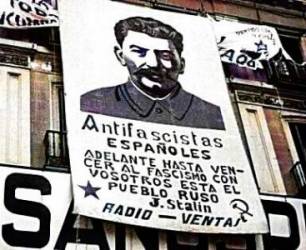
straightaway TELEGRAM FROM THE CENTRAL COMMITTEE OF THE COMMUNIST PARTY OF THE SOVIET UNION TO THE CENTRAL COMMITTEE OF THE COMMUNIST PARTY OF SPAIN. October 16, 1936.
straightaway REPORT AND SPEECH IN REPLY TO DEBATE AT THE PLENUM OF THE CENTRAL COMMITTEE. March 3-5, 1937.
straightaway LETTER TO THE CENTRAL COMMITTEE OF THE ALL-UNION COMMUNIST YOUTH ON PUBLICATIONS FOR CHILDREN. February 16, 1938.
straightaway ON THE PROHIBITION OF THE EXCLUSION OF KOLKHOZINES FROM THE KOLKHOZES. April 19, 1938.
straightaway ON THE INCORRECT DISTRIBUTION OF REVENUES IN THE KOLKHOZES. April 19, 1938.
straightaway SPEECH DELIVERED TO HIGHER EDUCATIONAL WORKERS AT A RECEPTION IN THE KREMLIN. May 17, 1938.
straightaway OATH OF ALLEGIANCE OF THE WORKERS' AND PEASANTS' RED ARMY. February 23, 1939.
straightaway REPORT OF THE CENTRAL COMMITTEE TO THE EIGHTEENTH CONGRESS OF THE COMMUNIST PARTY. March 10, 1939.
straightaway News from Galiciana: KIROV, ZINOVIEV, BUKHARIN AND STALIN.
1. THE DEATH OF KIROV.
(December 1, 1934. Pravda, December 2, 1934)
A great sorrow has befallen our Party. On December 1st, Comrade Kirov fell victim to the hand of an assassin, a scallawag sent by the class enemies.
The death of Kirov is an irreparable loss not only for us, his close friends and comrades, but also for everyone acquainted with his revolutionary work or who knew him as a fighter, comrade, friend. A man is dead, victim of the enemy, who gave all his brilliant life to the cause of the working class, to the cause of Communism, to the cause of the liberation of humanity.
Comrade Kirov was an example of Bolshevism who admitted neither fear nor difficulties in the pursuit of the great goal set by the Party. His integrity, his iron will, his astonishing attributes as an orator inspired by the Revolution commingled with such cordiality and tenderness in his private dealings with comrades and personal friends, such warmth and modesty;—all these the traits of a true Leninist.
Comrade Kirov worked in different locations of the U.S.S.R. through the epoch of illegality and after the October Revolution: Tomsk, Astrakhan, Vladicaucase and Baku. Everywhere he upheld the high standard of the Party and won millions of workers for the Party with his revolutionary untiring dynamic fruitful effort.
Over the past nine years Comrade Kirov headed our Party cell in Lenin's town and the Leningrad Oblast. There is no way to convey through a short and sad letter the esteem the workers of Leningrad had for his work. It would have been difficult to find in our Party a leader who could harmonize with the working class of Leningrad more closely, who could so ably rally all Party members and the entire working class around the Party. He imbued the whole Leningrad organization with the same spirit of discipline, love and Bolshevik devotion to the Revolution that characterized Comrade Kirov himself.
You were near to us all as a trusted friend, Comrade Kirov, a beloved comrade, a loyal comrade-in-arms. We will remember you, dear friend, until the end of our life and struggle—we feel bitterness at our loss.
You were always with us in the difficult years of the struggle for the victory of Socialism in our country, you were always with us through the years of uncertainty and intra-Party squabbles, you bore with us all the burdens of those years. We have lost you at the precise moment when our country has obtained great victories. In all those struggles, in all our accomplishments, you are very much in evidence—your energy, your fortitude and your ardent love for the Communist cause.
Farewell, Sergei, our dear friend and comrade.1,2
J. Stalin, S. Ordjonikidze, V. Molotov, M. Kalinin, K. Voroshilov, L. Kaganovich, A. Mikoyan, A. Andreyev, V. Tchoubar, A. Idanov, V. Kuibyshev, Ia. Roudzoutak, S. Kosior, P. Postychev, G. Petrovsky, A. Ienoukidze, M. Chkiriatov, Em. Iaroslavski, N. Ejov.
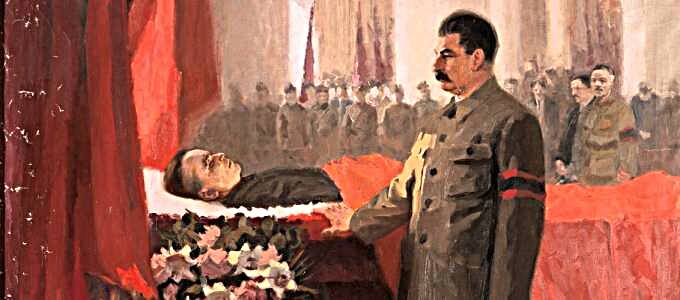
1 The painting of J. V. Stalin standing beside Kirov's bier (above, right) comes from the Kirov Museum webpage entitled, "Kirov's Death: Facts and Versions."
Letter from O. G. Shatunovskaya to A. N. Yakovlev about the circumstances of the murder of S. M. Kirov September 5, 1988
To: Comrade A. N. Yakovlev, member of the Politburo of the Central Committee of the Communist Party of the Soviet Union.
From:Olga Grigoryevna Shatunovskaya, member of the Communist Party of the Soviet Union since 1916. Last job: member of the Party Control Committee under the Central Committee of the Communist Party of the Soviet Union.
Dear Alexander Nikolaevich!
I am a member of the commission created by the Politburo in 1960, headed by N.M. Shvernik, to investigate the trials of the 1930s.
In accordance with the decision of the Twentieth Congress of the Communist Party of the Soviet Union (N.S. Khrushchev's report was adopted by that congress as a resolution of the congress) we investigated the circumstances surrounding the murder of S.M. Kirov.
This is what was unearthed:
Despite the triumphant tone of the Seventeenth Party Congress [January 26 to February 10, 1934] and the ovations for Stalin, a secret meeting of some Central Committee members—Kosior, Eikhe, Sheboldaev, Sharangovich and others—was held in Sergo Ordzhonikidze's apartment (a small house near the Trinity Gate). The participants deemed that Stalin's removal from the post of General Secretary was essential. They proposed Kirov as his replacement, but Sergei Mironovich [Kirov] refused.
After Stalin got wind of this meeting, he summoned Kirov. Kirov did not deny the meeting and said that Stalin's own actions had brought it about.
Stalin's name was crossed out on two hundred and ninety-two ballots cast in the elections to the Central Committee held during the Seventeenth Party Congress. Stalin ordered two hundred and eighty-nine adverse ballots burned. The minutes of the congress then announced a total of three votes against.
The Politburo commission examined the ballots and the voting records kept at the Central Party Office and established the fact that Stalin's re-election to the post of General-Secretary had been fraudulent. V. M. Verkhovykh the Deputy Returning Officer of the Voting Count Centre at the Seventeenth Party Congress was summoned to the Central Committee and furnished the details of the incident.
Following the Seventeenth Party Congress almost all the congress delegates were killed.
Thirty-nine out of the forty-one members of the Voting Count Centre were shot. The two who survived were repressed.
Kirov realized that now he too would inevitably be dispatched by Stalin and he informed his family and friends that his head was on the chopping block.
Kirov's assassin, Nikolaev, was detained three times by Kirov's security guards. He was found carrying a briefcase with a slit in the back concealing a loaded revolver and a floor plan of the Smolny. Withal Leningrad G.P.U. officers released him every time and threatened Kirov's guards instead.
Nikolaev showed up at Tauride Palace on December 1 for a Party meeting where Kirov was scheduled to deliver a report. Nikolaev was alerted that Kirov had gone back to the Smolny to get materials for the report and he was driven there.
During an interrogation at the Smolny the day after the murder Nikolaev stated in the presence of Stalin that G.P.U. officers had been pressuring him for four months to commit the murder, telling him that it was necessary for the Party and for the State.
Kirov's personal bodyguard, Borisov, who had warned him of impending danger, was murdered on the truck taking him for interrogation by Stalin at the Smolny. The G.P.U. escort struck Borisov on the head with a crowbar.
Our investigation found a handwritten list of two bogus "Trotskyist-Zinovievite terrorist centers" in Stalin's personal archive. One center was assigned to Leningrad and the other to Moscow. Stalin first put Zinoviev and Kamenev in the "Leningrad center" but on the second list he transposed them to the "Moscow center" in conjunction with other names.
Katsafa, a G.P.U. agent planted in Nikolaev's cell, wrote to the commission that the murderer had agreed to give investigators the testimony they sought for the alleged existence of a "Trotskyist-Zinoviev center" only after being promised that his life would be spared.
At the trial, presided over by Ulrikh, Nikolaev initially recanted the confession extracted from him and stated that no such center existed. Ulrikh isolated and interrogated Nikolaev and eventually broke him. He was segregated during a recess and again shouted that no such center existed and that he had incriminated innocent people (see the letter from guard Gusev to N.S. Khrushchev). After hearing the death sentence verdict, Nikolaev shouted repeatedly, "They deceived me! They deceived me!" Ulrikh's current wife, present in that courtroom, testified this to the commission.
A thorough investigation of many other important clues, the testimony of persons close to Kirov plus the testimony of other witnesses—every one—led to the irrefutable conclusion that Stalin had planned Kirov's murder.
Stalin unleashed a horrific reign of terror on the country after Kirov's assassination. Arrest orders were sent to all the republics and regions. A directive signed by Stalin and Molotov ordered show trials to be held in all districts—if suitable, in churches wherever large venues were unavailable.
The U.S.S.R. State Security Committee sent a document to the investigative commission with the yearly tally of people repressed. A total of 19,840,000 "enemies of the people" was arrested between January 1, 1935, and June 22, 1941. Seven million were executed in prison and most of the remainder perished in the camps.
The final report of the investigative commission with the attachment of the inspection by the handwriting expert of the U.S.S.R. Prosecutor's Office was sent to the members of the Politburo. All documents and materials from the investigation, including Stalin's manuscript, were destined to be kept in the Politburo Archives.
The resistance that our investigation met from Stalin loyalists was intense. After my departure in 1962 from the Communist Party of China [sic], individuals in N. S. Khrushchev's entourage moved to review the Politburo Commission findings. They instructed Z. G. Serdyuk the Deputy Chairman of the Communist Party of China 1 to interrogate the key witnesses once more. This work was carried out by G. S. Klimov.
A completely different conclusion was drawn (signed by whom I don't know). The review commission concluded that there was not enough evidence to incriminate Stalin in the assassination of Kirov.
Realizing the full extent of my responsibility to the Party for this testimony I request a thorough investigation into the circumstances surrounding the overturning of the Politburo Commission's original conclusion.
This must be done to restore the full truth.
O. Shatunovskaya
RGANI. F. 5. Op. 102. D. 1000. L. 23-25. Original. Typescript.
1They instructed Z. G. Serdyuk the Deputy Chairman of the Communist Party of China - Z. T. Serdyuk was in fact the First Deputy Chairman of the Party Control Committee under the Central Committee of the Communist Party of the Soviet Union. Russian source: net-film.ru.
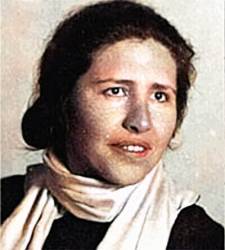
2 The photograph of O. G. Shatunovskaya (above, left) comes from this Russian webpage entitled, "Olga Grigorievna Shatunovskaya." The original B/W was colorized with Lunapic.
2. TALK WITH THE METAL PRODUCERS.1
(December 26, 1934. Izvestia, December 29, 1934)
...We had all too few technicians.
We were faced with a dilemma: either start by giving people technical training in schools for ten years before embarking on production and mass operation of the machines or proceed immediately to manufacture and operate machines, training and forming cadres from the get-go.
We chose the second option, assuming frankly and deliberately the inevitable fees and overspending that would ensue from the shortage of skilled operators. True, not a few machines got damaged, but on the other hand we gained what was most precious—time—and trained what is most valuable in the sphere of production: cadres.
In three to four years we formed cadres proficient both in the manufacture of machines of all types (tractors, automobiles, tanks, airplanes, etc.) and in their operation. What took Europe decades to achieve we were able to do, in the rough and in the main, in three to four years. The fees and the overspending, damaged machines and other losses were repaid and more than repaid.
That's the basis of the quick industrialization of our country. But we would not have made it if our iron-and-steel industry had not been racing ahead alongside us, had not been thriving.
We have every right to boast about our great successes in the iron-and-steel industry, the driving force of our national economy. We have succeeded, it's true. But we must not become conceited. The most dangerous thing is when people grow smug with their successes, forget the shortcomings and forget that more tasks lay in the offing...
[...]
Technology cannot be dissevered from technicians. Without technicians technology is dead. The Party slogan, "In the period of reconstruction technology decides everything," refers not to bare technology but to those who have mastered it. That's the only correct understanding of the slogan. And since we have already learnt to value technology it is time to declare plainly that the chief thing now is the people who have mastered it. But it follows from this that while the main emphasis formerly was laid on technology, on machinery, the emphasis now must be laid on the technicians. This is what our slogan demands.
We must cherish every capable and intelligent worker, we must cherish and nurture him. People must be tended to as tenderly and carefully as a gardener tends his favourite fruit tree. We must train, offer prospects, promote at the right time, shift to another job at the right time and not delay until he comes to grief.2
In order to create a big army of production and technical cadres we must cultivate and train people carefully, we must set them in production properly, assign wages to bolster production and induce people to improve their vocational skill...3,4
1 On December 26, 1934, Comrades Stalin, Molotov and Orjonikidze met with a delegation of directors, engineers and metal workers to discuss the successful fulfilment of the production goals for 1934. In the course of the interview Stalin spoke about the tasks facing the iron and steel industry and about certain important issues of socialist development.
2We must train, offer prospects, promote at the right time, shift to another job at the right time and not delay until he comes to grief - The following extract comes from this Russian webpage entitled, "Comrade Koppa."
Please note: I have modified the translated Google version slightly.
Comrade Koppa
(Magnitogorsk Metall newspaper, 2005-2026)
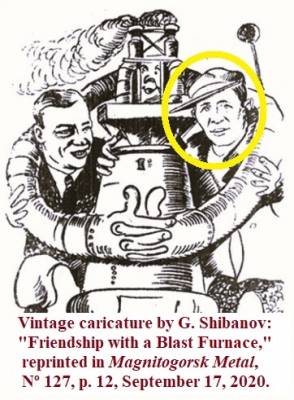
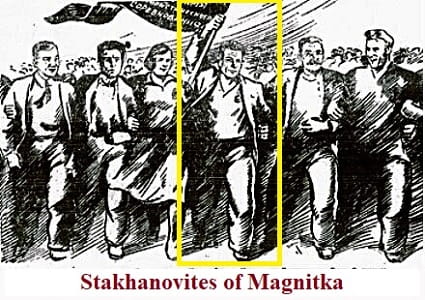
Thanks to the "Books of Memory" written by Magnitogorsk researcher and enthusiast Gennady Vasiliev it was possible to discover the names of blast-furnace workers repressed in 1937-1938. One of them was Pyotr Koppa, the originator of Stakhanovite methods of work in the blast-furnace workshop of Magnitogorsk Iron and Steel Works and the secretary of the local Party cell. He was married and had two sons, Vova and Yura, who were born in the same year. He was executed in 1938 when he was only thirty-three years old. Information about him was found in the archives of the plant: a small envelope with his personal file nearly crumbled to dust.
Pyotr Fedorovich Koppa was born in Dnepropetrovsk on January 25, 1905. He graduated from college, served in the Army and fought on the Wrangel Front. As a metallurgical plant worker he graduated from rolling mill operator to assisting the blast-furnace manager. This intelligent employee was sent to Moscow in 1932. There he met the head of the Human Resources Department at Magnitogorsk Iron and Steel Works who offered him employmet as a branch head. Koppa accepted his offer.
In March 1934 Koppa was made foreman of Blast Furnace No. 1. Together with co-workers he put the furnace at the forefront of the All-Union Metallurgical Competition. On December 31 the furnace was named after S. Kirov; by then it produced 11% of all the low-grade pig iron smelted in the Soviet Union.
The Stakhanovite drive became a mass movement in October 1935. Foreman Koppa was the first one to implement the Stakhanovite attitude in the workshop. The best Stakhanovites, the pioneers of advanced methods, were from Blast Furnace No. 1. There were no accidents. Instead of an assigned output goal of 414 tons they smelted 438 tons, sometimes even 636.
The Koppa family enjoyed a very pleasant standard of living. The touch of Alexandra Pavlovna the landlady imbues their cozy two-room apartment. A portrait of Comrade Stalin hangs over the table in the nursery.
On December 2, 1935, the plant director appointed Comrade Koppa head of the bottling machine shop, replacing a previous manager who had shown "an outrageously negligent attitude." Koppa raised the bottling machines to "exemplary combat fitness" and was commended for it.
On July 9, 1936, a Party meeting was held to elect a representative to travel and report back to the Party centre in Moscow. The Bolsheviks of Blast Furnace No. 1 chose Pyotr Koppa unanimously. Eight months later the Secretary of the All-Union Communist Party (Bolsheviks) returned to his job as foreman of Blast Furnace No. 1, first brigade.
On May 10, 1937, Koppa went on a 36-day holiday during which he fell ill and was handed a Sick-Leave Certificate prescribing a return-to-work date of August 19.
Instead Koppa reported for work on August 20 and concealed his misdemeanor from management. Timekeeper Titov did not snitch on Koppa and for that he was accused of negligence and executed in September 1937.
Pyotr Koppa was fired from his job on August 25, 1937, and executed a year later on August 28, 1938.
One NKVD officer who survived to this day (October 29, 2013) recounted: "We were required to unearth conspiracies and execute hundreds of construction workers and metalworkers. Each region received a quota: how many were to be repressed under the first category—execution—and how many under the second—eight to ten years in labor camps. No one was spared, neither foremen nor workers."
After Stalin's death the Ural Military District Tribunal reviewed the cases and the repressed were rehabilitated posthumously.
Repressed blast furnace operators of the Magnitogorsk Iron and Steel Works
Trofim Grigorievich Gubenko, born in 1897, native of the village of Potashnaya, Kaniv district, Kyiv region. Member of the All-Union Communist Party (Bolsheviks) since 1927. Chief foreman of the blast furnace shop. Executed on August 8, 1937.
Aleksandr Kirillovich Zhidin, born in 1901, head of the blast furnace shop. Executed on August 10, 1937.
Grigory Vasilyevich Titov, born in 1907, timekeeper in the blast furnace shop. He was executed on September 29, 1937, for negligence in the performance of his duties.
Anin, Kharlampy Alekseevich, born in 1908, a furnace worker. Sentenced to ten years in a correctional labor camp on October 10, 1937.
Nikolai Vasilyevich Klishevich, born in 1885, head of the blast furnace shop and chief engineer at Magnitogorsk Iron and Steel Works. His daughter, Natalya Nikolaevna, wrote about him at the time. More details about him can be found in the book "Magnitka's Blast Furnace Shop: Deeds and People," pp. 244-250. He was executed on November 5, 1937.
Aleksey Yakovlevich Borovikov, born in 1906, assistant scale car driver. Sentenced to death. Executed on November 8, 1937.
Mikhail Ivanovich Letko, born in 1911, was a native of the village of Vytreski, Vileika District, Vilnius Governorate, Poland. He was a blast furnace mechanic and plumber and was executed on November 20, 1937.
Aituganov Pavel Stepanovich, born in 1886, mechanic of the blast furnace shop. Sentenced to death. Executed on January 26, 1938.
Ilya Ivanovich Medvedev, born in 1890, was a native of the village of Arsi, Nagaybaksky District, Chelyabinsk Region. He worked as a bathhouse attendant in the blast furnace shop and was executed on January 26, 1938.
The open list of victims of political repression contains this file on Pyotr Koppa:
Koppa Petr Fedorovich (1905)
Place of birth: Ukrainian SSR, Dnepropetrovsk.
Social origin: from the workers.
Education: secondary.
Profession/place of work: Blast Furnace No. 1, Blast Furnace Master.
Place of residence: Chelyabinsk region, Magnitogorsk.
Party affiliation: none.
Date of execution: July 28, 1938.
Date of arrest: November 3, 1937.
Sentenced: July 28, 1938.
Condemning body: Military Collegium of the Supreme Court of the U.S.S.R.
Article: 58-7, 58-8, 58-11.
Sentence: capital punishment (execution by firing squad).
Date of rehabilitation: October 29, 1957.
Rehabilitating body: Military Collegium of the Supreme Court of the U.S.S.R.
Archival file: GU OGACHO. F. R- 467. Op. 4. D. 2318, 2317.
3 Stalin's speech was followed by a lively exchange of views which lasted about seven hours without interruption. Responsible workers in the iron and steel industries, mill directors, technical directors, foremen, Party workers and shock workers took part in the conversation and dwelt in detail on the prospects for the iron and steel industry in 1935, on ways of resolving the problems cited by Stalin and on the general spirit of creative enthusiasm prevailing at the mills.
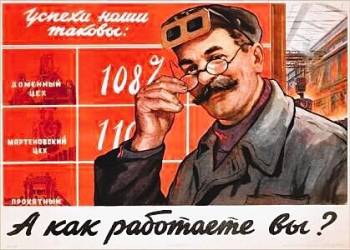
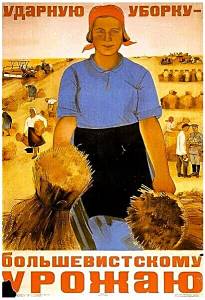
4 The metallurgy poster (first from the top, right) comes from this Russian webpage entitled, "How do you work? A unique poster highlighting the successes of Soviet metallurgy."
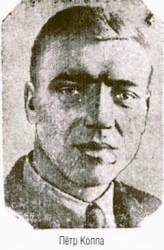
The daguerreotype of Pyotr Koppa (second from the top, left) comes from Elena Bryzgalina's article on page 12 of this Russian magazine. The heading of Bryzgalina's column is "Forever in the Thirties" and the article is entitled, "He chose the job of a blast furnace operator over a Party career and became one of Magnitka's most famous Stakhanovites."
The vintage caricature of Pyotr Koppa and a top manager embracing Blast Furnace No. 1 (above, right) drawn by Gennady Shibanov also comes from Elena Bryzgalina's article, and so does the illustration captioned, "Stakhanovites of Magnitka" (above, left).
3. ADDRESS TO THE GRADUATES FROM THE RED ARMY ACADEMIES.
(May 4, 1935. Pravda, May 6, 1935)
May 4, 1935, at the Kremlin
Comrades, it cannot be denied that we have made great headway in the last few years both in the sphere of construction and in the sphere of administration. In this connection there is too much talk about the services rendered by chiefs, by leaders. They are credited with all or nearly all our achievements. That is of course wrong, it's incorrect, it's not merely a matter of leaders. But that's not what I wanted to talk about today. I should like to say a few words about cadres, about our cadres in general and about our Red Army cadres in particular.
You know that we inherited a technically backward, impoverished and ruined country—ruined by four years of imperialist war and ruined by three additional years of civil war—a country with a semi-literate population, a low technological level and scattered industrial oases lost in a sea of dwarf peasant farms: such was the country we inherited.
The task was to take this country from a state of mediaeval darkness to the terrain of modern industry and mechanized agriculture; a serious and difficult undertaking as you can see. The question that confronted us was: Either we solve this problem in the shortest time possible and consolidate Socialism in our country or we do not, in which case our country, technologically weak and culturally unenlightened, will lose its independence and become a stake on the gameboard of the imperialist powers.
In those days our country displayed an appalling dearth of machinery. There weren't enough machines for industry, for agriculture or for transportation. It lacked that elementary technological base without which a country's transformation along industrial lines is inconceivable. There were only isolated shoots of such a base.
A first-class industry had to be built from scratch. This industry had to empower industry, agriculture and our railway transportation system. And to achieve this it was necessary to make sacrifices and to exercise the most rigorous economy in food, schools and textiles in order to save enough funds for the creation of a first-class industry.1
There was no other way of overcoming the dearth of technology. That's what Lenin taught us and in this matter we followed in Lenin's footsteps.2
Uniform and rapid success could not naturally be expected in so great and difficult a task like this one. Successes become apparent only after several years. We therefore had to arm ourselves with strong nerves, Bolshevik grit and steadfastness to overcome our first failures and march unswervingly toward the great goal without tolerating any wavering or skepticism in our ranks.
You know that's precisely how we set about this task. But not all our comrades had the required spirit, patience and grit. There turned out to be people amongst us who at the first difficulties began to call for a retreat.
"Let bygones be bygones," it is said. That is of course true. But man is endowed with memory and in reviewing the outcome of our labour one recalls the past involuntarily...
(Animation)
Well then, there were comrades among us who were frightened by the difficulties and began to call upon the Party to retreat. They said: "What is the good of your industrialization and collectivization, your machines, your iron and steel industry, tractors, harvester combines, automobiles? You should instead have given us more textiles, bought more raw materials for the production of consumers' goods and provided the people at large with more of those small items which make life pleasant. The creation of a first-class industry when we are so backward is a dangerous dream."
Of course we could have spent the 3,000 million rubles we obtained in foreign currency (as a result of a most rigorous economy for the purpose of creating our industry) on importing raw materials instead and increasing the manufacture of general consumption items. That's also a "plan" in a way; but with such a "plan" we would not have a metallurgical industry today nor a machine-building industry or tractors, automobiles, airlanes and tanks. We would have found ourselves unarmed in the face of foreign foes. We would have undermined the foundations of Socialism in our country. We would have fallen captive to the bourgeoisie, home and foreign.
It's obvious that a choice had to be made between the plan of retreat (which would have led inevitably to the defeat of Socialism) and the plan of advance which led and has already brought us to, as you know, the victory of Socialism in our country.
We chose the plan of advance and moved forward along the Leninist road, brushing aside those comrades as individuals who could more or less see what was under their noses but who shut their eyes to the immediate future of Socialism in our country.
But these comrades did not always confine themselves to criticism and passive resistance. They threatened to raise a fracas inside the Party against the Central Committee. Indeed they threatened some of us with bullets. Evidently they reckoned on frightening us and compelling us to turn from the Leninist road. These people forgot apparently that we Bolsheviks are made of a special cut. They forgot that neither difficulties nor threats can frighten Bolsheviks. They forgot that we had been trained and steeled by the great Lenin, our leader, our teacher, our father, who knew and brooked no fear in the struggle. They forgot that the more the enemies rage and the more hysterical the foes inside the Party become, the more ardently Bolsheviks lurch toward fresh struggles and the more vigorously they push forward.
Of course it never occurred to us to turn away from the Leninist road. Moreover once we set foot firmly on this road we pushed forward still more vigorously, removing every obstacle from our path. True, in pursuing this policy we were obliged to handle some of those comrades roughly. But that cannot be helped.
I must confess that I too had a hand in this.
(Loud cheers and applause)
[...]
I recall an incident in Siberia where I lived at one time in exile. It was during the spring floods. About thirty men went to the river to pull out lumber that had been carried away by the vast swollen river. They returned to the village towards evening, one comrade missing. When asked where the thirtieth man was, they replied
indifferently that the thirtieth man had "stayed back there." To my question, "What do you mean, stayed back there?" they replied with the same indifference,
"Why ask? Drowned, of course." One of them began to hurry away, saying, "I've got to go and water the mare." When I reproached them for having more concern for animals than for men, one of them said amid the general approval of the rest, "Why should we be concerned about men? We can always make men. But a mare...just try making a mare."
(Animation)
Here you have a case, not very significant perhaps but very typical. It seems to me that the indifference of certain of our leaders to people, to cadres—their
inability to value people—is a survival of that strange attitude of man to man displayed in that episode of faraway Siberia I have just related.3
And so, comrades, if we want to beat the dearth of people successfully and provide our country with sufficient cadres capable of improving technology and get it going, we must learn first of all to value people, value cadres, value every worker capable of advancing our common cause. It's time to realize that out of all the valuable capital the world possesses, the most valuable and most decisive is people, cadres. It must be realized that "cadres decide everything" presently.
If we have good and numerous cadres in our industry, agriculture, transportation and in the Army our country will be invincible. If we do not have such cadres we shall be lame in both legs.
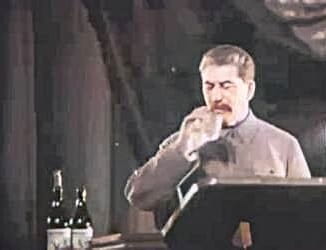
In concluding my speech, let me propose a toast to the health and success of our graduates from the Red Army Academies. I wish them success in the task of defining and directing the defence of our country.
Comrades, you have graduated from institutions of higher learning where you got your first tempering. But school is only a first step. Cadres receive their real tempering in practical work outside school, in fighting and overcoming challenges. Remember, comrades, that only those cadres are any good who do not fear challenges, who do not eschew them but, on the contrary, go out to meet them, tackle and beat them. It is only in the struggle against challenges that real cadres are forged. And if our Army possesses really steeled cadres in sufficient numbers, it will be invincible.
To your health, comrades!
(Stormy applause. All rise. Loud cheers for Comrade Stalin)
1it was necessary to make sacrifices and to exercise the most rigorous economy in food, schools and textiles in order to save enough funds for the creation of a first-class industry - See Chapter 13, Item 4, footnote 6: "It is also necessary to discuss how exactly the industrialization materialized. The funds ["accumulations"] were obtained by selling to Western countries the valuables that had been snatched from the "bourgeoisie" or by selling abroad the grain appropriated from the peasants at the cost of the Holodomor and millions of victims."
2That's what Lenin taught us and in this matter we followed in Lenin's footsteps - Hence it is a mistake to counterpose Lenin ("good") to Stalin ("bad"). Both were cut from the same cloth (Chapter 13, Item 5, and Collected Works of V. I. Lenin & Galiciana, Chapter 29, Item 7; Chapter 30, Item 5).
3It seems to me that the indifference of certain of our leaders to people, to cadres—their inability to value people—is a survival of that strange attitude of man to man displayed in that episode of faraway Siberia I have just related - A case of the pot calling the kettle black.
4. SPEECH DELIVERED AT A RECEPTION GIVEN BY LEADERS OF THE COMMUNIST PARTY AND OF THE GOVERNMENT TO WOMEN COLLECTIVE FARM SHOCK WORKERS.
(November 10, 1935. Pravda, November 11, 1935)
November 10, 1935
Comrades, what we have seen here today is a slice of the new life we call the collective life, the socialist life. We have heard the simple accounts of simple toiling people, how they strove and overcame difficulties in order to achieve success in socialist competition. We have heard the speeches not of ordinary women but, I would say, of women who are heroines of labour because only heroines of labour could have achieved the successes they have achieved. We had no such women before.
Here am I, already 56 years old, I have seen many things in my time, I have seen many labouring men and women. But I have never met such women. They are an absolutely new type of individual. Only free labour, only collective farm labour could have given rise to such heroines of labour in the countryside.
There were no such women, there could not have been such women in the old days.
Indeed just ponder what the status of women was before, in the old days. As long as a woman was unmarried she was regarded as the lowest of toilers. She toiled for her father, she worked ceaselessly and nevertheless her father would keep reproaching her, "I feed you." When she got married she would toil for her husband, she would toil just as much as her husband would compel her to work and her husband too would keep reproaching her, "I feed you." A peasant woman was the lowest of toilers. Naturally no heroines of labour could arise under such circumstances. Labour in those days was a curse to a woman, and she would avoid it as much as she could.
Only the collective farm life could have made labour a thing of honour, have bred genuine heroines of the countryside. Only the collective farm life could have erased inequality and put woman on her feet. You yourselves know that very well.
The collective farm introduced the workday. And what is the workday? Everybody has equal status before the workday, men and women. Whoever has the most workdays to his credit earns the most. Here neither father nor husband can reproach a woman, saying that he is feeding her. Presently if a woman toils and has workdays to her credit, she is her own master.
I remember conversing with several women comrades at the Second Collective Farm Congress. One from the Northern Territory said:
Two years ago no suitor would have even set foot in our house, I had no dowry! Now I have five hundred workdays to my credit. And guess what? Suitors give me no rest, all say they want to marry me, but I will take my time and select my own young man.
The collective farm has liberated women and made her independent by way of the workdays. She no longer works for her father if she is single but works primarily for herself. And that's precisely what the emancipation of peasant women means. That's what is meant by the collective farm system making a working woman equal to every workingman. Only on these grounds, under these conditions, could such splendid women bud. That's why I regard today's meeting as not just another reunion of prominent people with members of the government but as a solemn day on which the achievements and capacities of the emancipated labour of women are being demonstrated.
I think the government should confer awards on the heroines of labour who came here to report their accomplishments to the government.
How should this day be commemorated?
Comrades Voroshilov, Chernov, Molotov, Kaganovich, Orjonikidze, Kalinin, Mikoyan and I have discussed this matter and agreed to request the government to reward our heroines of labour with the Order of Lenin for the team leaders and the Order of the Banner of Labour for the regular shock workers.
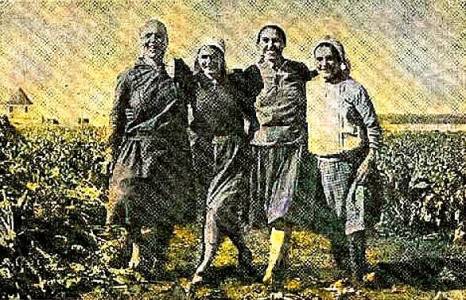
Comrade Maria Demchenko will of course have to be singled out particularly.1
Voroshilov: Good girl!
Molotov: The chief culprit!
Stalin: I think that Maria Demchenko, as pioneer in this matter, in addition to being awarded the Order of Lenin should receive the thanks of the Central Executive Committee of the Soviets, and the female collective farmers in her team should be awarded the Order of the Banner of Labour.
A voice: They are all here except one, she is ill.
Stalin: The sick one must also be rewarded. That's how we intend to commemorate this occasion.
Maria Sofronovna Demchenko (1912-1995) was a Soviet collective farmer, agronomist and the initiator of a mass movement for harvesting the biggest possible crops of sugar beet in collective farms.
Little is known about her early life. Owing to her prolific work she was appointed team leader of the Comintern collective farm in the Gorodishchensky district in 1930, a position she held until 1936.
She was a delegate to the 2nd All-Union Congress of Shock Workers in Collective Farms in 1935 where she spoke and promised Stalin to raise sugar beet production to 500 cnt/hectare. She soon surpassed this target and harvested 523.7 cnt/hectare. Her success spawned the so-called "Five Hundreds Movement" which became a major socialist competition.
She was a deputy of the Supreme Soviet of the U.S.S.R. between 1937-1946.
She graduated from Kiev Agricultural Institute in 1945 and joined the Vasiliev Collective Farm of the Dymersky district (Kiev Region) as an agronomist. In 1958 she enrolled in graduate school at the Ukrainian Academy of Agricultural Sciences.
She graduated in 1961 and returned to the Vasiliev Farm, now a state farm. She made several experiments there and retired in 1965.
Her death in 1995 went unnoticed. She was buried in her native village.
Addendum: Maria Demchenko also wrote the book, "How I became the leading songstress of the Five Hundred," published in 1937 by the Komsomol Central Committee.
2 The 1936 photograph of the "Maria Demchenko Team" (above, right) comes from V. Shmerling's book entitled, "Maria Demchenko," published in 1936 by the Young Guard and reprinted on this Russian webpage. The foursome are from left to right, Yarina Tkachenko, Maria Demchenko, Priska Savchenko and Marina Gnatenko. The grainy B/W original was colorized using Lunapic.
5. INTERVIEW BETWEEN J. STALIN AND ROY HOWARD.1
(March 1, 1936. Pravda, March 5, 1936)
[...]
Howard: The entire world today is apparently predicting another great war. If war proves inevitable, when, Mr. Stalin, do you think it will arrive?
Stalin: It's impossible to predict that. War may break out unexpectedly. Wars are not declared nowadays, they simply start. On the other hand I think that the position of the friends of peace is solidifying.
The friends of peace can do their work openly. They rely on the power of public opinion. They have at their command tools like the League of Nations, for example. This is where the friends of peace hold the advantage. Their strength lies in the fact that their stance against war is backed by the broad masses of the people. No people in the world wants war.
As for the enemies of peace, they are compelled to work covertly. That's where the enemies of peace are at a disadvantage. Incidentally it is not precluded that precisely because of this disadvantage they might be tempted launch a military adventure in desperation.
One of the latest successes credited to the friends of peace is the ratification by the French Chamber of Deputies of the Franco-Soviet Pact of Mutual Assistance. To a certain extent this pact acts as a buffer against the enemies of peace.
Howard: Should war come, Mr. Stalin, where is it most likely to break out? Where are the war clouds most ominous, in the East or in the West?
Stalin: In my opinion there are two areas of potential conflict. The first one is situated in the region of Japan. I have in mind the numerous threats made by Japanese military officers against other powers. The second area is located in the region of Germany. It's hard to say which is the most dangerous, but both exist and are active. Compared to these two the Italo-Abyssinian war is just an episode.
At present the Far East exudes the greatest activity, but the danger may shift to Europe. This is indicated, for example, by the interview which Herr Hitler recently gave to a French newspaper. In this interview Hitler tried to unpack peaceful statements but he sprinkled them so plentifully with threats against both France and the Soviet Union that nothing remained of his "peaceful" intentions.
You see, even when Herr Hitler wants to talk peace he cannot help uttering threats. This is a symptom.
Howard: What situation or condition furnishes, in your opinion, the chief threat of war today?
Stalin: Capitalism.
Howard: Which specific property of capitalism?
Stalin: Its imperialist usurpatory property. You remember how the first World War arose. It arose out of the desire to re-partition the world. Today we have the same backdrop. There are capitalist states which believe that they were cheated out in the previous redistribution of the spheres of influence, territories, sources of raw materials, markets, etc. These states desire a novel partition advantageous to them.
Capitalism is in its imperialist phase a system that views war as a legitimate instrument for settling international disputes—a legal avenue in fact even if it's not written down in law.
[...]
1 On March 1, 1936, Comrade Stalin granted an interview to Roy Howard the President of Scripps-Howard Newspapers.
6. TELEGRAM FROM THE CENTRAL COMMITTEE OF THE COMMUNIST PARTY OF THE SOVIET UNION TO THE CENTRAL COMMITTEE OF THE COMMUNIST PARTY OF SPAIN.
(Pravda, October 16, 1936)
The workers of the Soviet Union are merely carrying out their duty—within their means—when they send aid to the revolutionary masses of Spain.
They realize that the liberation of Spain from the yoke of Fascist reactionaries is not the private affair of the Spanish people but the concern of the whole of the advanced and progressive mankind.1
Fraternal greetings,
J. Stalin.
1 The 1936 photograph (above, left) comes from this Spanish webpage entitled, "The U.S.S.R., the Comintern and the Spanish Civil War: historiographic dimension [Andrey Fedorov]." The B/W original was colorized with Lunapic. The text of the poster says: "Spanish Antifascists. Forward until the victory over Fascism. The Russian people are with you. J. Stalin."
7. REPORT AND SPEECH IN REPLY TO DEBATE AT THE PLENUM OF THE CENTRAL COMMITTEE.
(March 3-5, 1937. Pravda, March 29, 1937)
DEFECTS IN PARTY WORK AND MEASURES FOR LIQUIDATING TROTSKYITE AND OTHER DOUBLE-DEALERS
Comrades, from the reports and the ensuing debates heard at this Plenum it is evident that we are dealing with the following three main facts.
First, the wrecking, diversionist and espionage work of the agents of foreign countries, among whom a rather active role was played by the Trotskyites, affected more or less all or nearly all our organizations, economic, administrative and Party.
Second, the agents of foreign countries—among them the Trotskyites—not only infiltrated our inferior-rank cells, they infiltrated a number of responsible posts also.
Third, some leading comrades at the centre and out in the districts not only failed to spot the true face of these wreckers, diversionists, spies and assassins but proved to be so careless complacent and naive that not infrequently they helped to promote foreign agents to responsible positions.
Such are the three incontrovertible facts that naturally emerge from the reports and ensuing debates here.
[...]
III. PRESENT DAY TROTSKYISM
[...]
At the trial in 1936 Kamenev and Zinoviev denied emphatically, if you remember, that they had a political platform. They had every opportunity to unfold their political platform but they did not do so, declaring they had none. There can be no doubt that both were lying when they denied having a political platform. Now even the blind can see that they had one.
But why did they deny having a political platform? Because they were afraid to show their true political face, they were afraid to expose their platform of restoring capitalism in the U.S.S.R. publicly, they were afraid because such an exposure would trigger revulsion in the ranks of the working class.
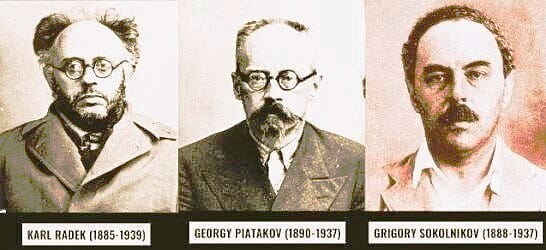
At the trial in 1937, Radek, Pyatakov and Sokolnikov took a different line. They did not deny that the Trotskyites and Zinovievites had a political platform. They admitted that they had a definite political platform, admitted it and unfolded it in their evidence. They unfolded it not in order to call upon the working class, to call upon the people, to support the Trotskyite platform but in order to curse it and brand it an anti-people and anti-proletarian platform.
The restoration of capitalism, the liquidation of collective farms and state farms, the restoration of the system of exploitation, an alliance with the fascist forces of Germany and Japan to provoke an aggression against the Soviet Union, a struggle against the policy of peace, the territorial dismemberment of the Soviet Union whereby the
Ukraine would go to the Germans and the Maritime Region to the Japanese, preparation for defeat of the Soviet Union in the event of aggression by hostile states and, as a means of achieving all these aims, wrecking, diversion, individual acts of terrorism against leaders of the Soviet government, espionage on behalf of the Japanese and German fascist forces—such was the political platform of present-day Trotskyism unfolded by Pyatakov, Radek and Sokolnikov.
Naturally the Trotskyites could not but conceal such a platform from the people, from the working class. And they concealed it not only from the working class but also from rank-and-file Trotskyites, and not only from the rank-and-file Trotskyites but even from the leading Trotskyite clique of thirty or forty people.
When Radek and Pyatakov asked permission from Trotsky to convene a small conference of thirty or forty Trotskyites for the purpose of ascertaining the nature of this platform, Trotsky forbade them to do so on the grounds that it was inexpedient to inform even a small clique of Trotskyites about the underlying nature of this platform, for such an "operation" might cause a split.
"Political figures" concealing their views and platform not only from the working class but also from the Trotskyite rank-and-file, and not only from them but from the leadership—such is the face of present-day Trotskyism. But it follows from this that present-day Trotskyism can no longer be called a political trend of the working class.
Present-day Trotskyism is not a political trend of the working class but a gang without principles or ideals, a gang of wreckers, diversionists, intelligence service agents, spies, assassins, a gang of sworn enemies of the working class in the pay of the intelligence services of foreign states. Such is the irrefutable result of the evolution of Trotskyism in the last seven or eight years. Such is the difference between the Trotskyism of the past and present-day Trotskyism.
The mistake that our Party comrades made is that they failed to notice this profound difference between the Trotskyism of the past and Trotskyism now. They failed to notice that the Trotskyites have long ceased to be people devoted to an ideal, that the Trotskyites long ago became highwaymen capable of any foul deed, capable of every disgusting feat—espionage and downright betrayal of their country—if only they can harm the Soviet government and Soviet power.
The comrades failed to notice this and therefore could not adapt themselves quickly enough to confront the Trotskyites in a new way, more resolutely.1
[...]
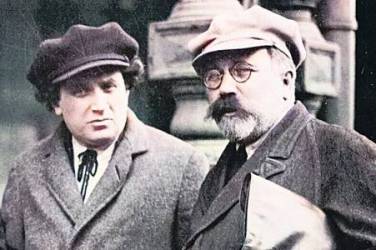
1 The 1925 photograph of Zinoviev and Kamenev (above, right) comes from Collected Works of V. I. Lenin & Galiciana, Chapter 30, Item 11. The 1937 photographs of Radek, Pyatakov and Sokolnikov (above, left) come from this Russian webpage entitled, "Political Genocide in the USSR (1936–1940): The Moscow Trials and the Dewey Commission."
8. LETTER TO THE CENTRAL COMMITTEE OF THE ALL-UNION COMMUNIST YOUTH ON PUBLICATIONS FOR CHILDREN.
(February 16, 1938. Voprosy Istorii, 11. 1953)
I am absolutely against the publication of "Stories of the Childhood of Stalin." 1
The book is filled with a mass of inexact facts, alterations, exaggerations and unmerited praise. Some amateur writers, scribblers (perhaps honest scribblers) and some toadies have led the author astray. It's a shame for the author but a fact is a fact.
But this is not the important thing. The important thing resides in the fact that the book has a tendency to engrave on the minds of Soviet children (and people in general) the personality cult of leaders and of infallible heroes. This is dangerous and detrimental.
The theory of the "heroes" and the "multitudes" is not a Bolshevik but a Social-Revolutionary theory.
Heroes make the people, transform the multitudes into a people, so affirm the Social-Revolutionaries. The people make the heroes, thus reply the Bolsheviks to the Social-Revolutionaries.
The book carries water to the windmill of the Social-Revolutionaries. No matter what book brings water to the windmill of the Social-Revolutionaries it must founder in our common Bolshevik cause.
I suggest that we burn this book.2
J. STALIN
1 Perhaps this version of Stalin's childhood written by Vladimir Evgenievich Solodikhin is less illusory.
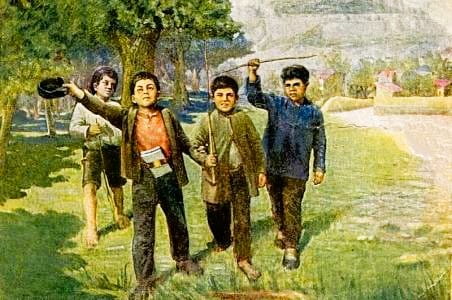
2 Dmitry Volgin's painting of Stalin in his youth (above, right) comes from this Russian webpage entitled, "Stalin in Painting: Childhood and Youth."
9. ON THE PROHIBITION OF THE EXCLUSION OF KOLKHOZINES FROM THE KOLKHOZES.1
(April 19, 1938. Pravda, April 20, 1938)
April 19, 1938
The Council of People's Commissars and the Central Committee have on several occasions warned local Party cells and Soviets against banning Kolkhozines from the Kolkhozes without any justification. The Council of People's Commissars and the Central Committee have shown more than once that such a practice is anti-Party and anti-Government.
Withal in many regions and across many Republics, this unjustified banishment of Kolkhozines persists. The exaggerations and distortions surrounding the banishment of Kolkhozines from the Kolkhozes have assumed ridiculous proportions in the administrative regions of Sverdlovsk, Novossibirsk, Smolensk, Kalinine, Kamenetz, Podolsk, Jitomir, in the regions of Altai, Krasnoda, Ordjonikidze and in the Kazakhstan S.S.R.
[...]
The most widespread misfeasance is the banishment of family members whose parents went to work at firms or enterprises of the State. Exclusion based on parental ties contradicts the statutes of the agricultural artel fundamentally.
The statutes of the agricultural artel foresee a set of preventive or educational measures before an official banishment of Kolkhozines is enacted. For example, a Kolkhozine is simply persuaded to redress a poor job during his normal working hours without issuing a warning, placing him on a black list, shifting the blame onto the commune at large, contravening the five-day week or suspending the Kolkhozine.
But the lines the Kolkhozes are adopting have not adhered to these measures, for some unknown reason, and very often banish Kolkhozines for a trivial breach of the communal regulations.
The statutes of the agricultural artel prescribe that banishment requires the approval of a general assembly with a quorum of not less than two thirds of all the artel members. This statutory law is very often ignored. The instances are not rare where a banishment of Kolkhozines is dictated by the authorities of the Kolkhoz directly and even by the president alone.2
Instead of repressing and correcting these harmful deeds, the worker-leaders of the Party and of the district Soviets do not act decisively but display an insensitive bureaucratic attitude that harms the Kolkhozines, an attitude that renders the legal provisions against banishment useless and grants immunity to the transgressors.
This complacent attitude in fact reduces the function of worker-leaders of the Party to that of mere registrars who simply concoct statistical reports for the leading Soviet organs. Worse, the workers themselves often prod Kolkhoze presidents and managers onto the road of lawless banishments under the excuse of purging the farms of foreign or hostile social elements from a class standpoint.3
[...]
1 This was published as a decree of the Council of People's Commissars of the U.S.S.R. and of the Central Committee of the Communist Party of the Soviet Union (Bolsheviks).
2The instances are not rare where a banishment of Kolkhozines is dictated by the authorities of the Kolkhoz directly and even by the president alone - Stalin may have forgotten these two instances of abuse of power by higher-ups against honest workers which he himself decried during the Fifteenth Party Congress (December 2-19, 1927),
Lastly, facts about "demoting." It appears that in addition to workers being promoted, some are "demoted" or pushed by their own comrades to the background, not because they are unfit or inefficient but because they are conscientious and honest in their work.
Here is a worker, a tool-maker, who was promoted to a managerial post at his plant because he was a capable and incorruptible man. He worked for a couple of years, worked honestly, introduced order, put a stop to inefficiency and waste. But by doing so, he stepped on the toes of a gang of so-called "Communists" and disturbed their peace and quiet. And what happened? This gang of "Communists" put a spoke in his wheel and compelled him to "demote himself" [resign] as much as to say, "You wanted to be smarter than us, you won't let us live and make a bit in quiet? Take a back seat, brother."
Here is another worker—a tool-maker also, an adjuster of bolt-cutting machines—who was promoted to a managerial post at his factory. He worked zealously and honestly. But by doing so, he disturbed somebody's peace and quiet. And what happened? A pretext was found to get rid of this "troublemaker." How did this comrade feel on departure, what were his feelings? Thus: "In whatever post I was appointed to I tried to justify the confidence placed in me. But this promotion played a dirty trick on me and I shall never forget it. They slung mud at me. My wish to bring everything into the light of day remained a mere wish. Neither the Works committee nor
management nor the Party cell would hear me out. I am done with promotions. I would not take another managerial post even if I were offered my weight in gold"
(Trud, 128, June 9, 1927).
But this is a disgrace to us, comrades! How can such outrageous abuses be tolerated?
(Collected Works of J. V. Stalin, 10, pp. 329-330)
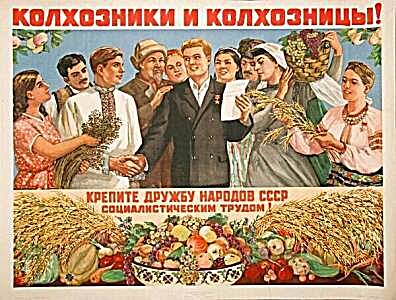
3 The poster (above, left) comes from this Russian webpage entitled, "USSR collective farm posters for copying."
10. ON THE INCORRECT DISTRIBUTION OF REVENUES IN THE KOLKHOZES.1
(April 19, 1938. Pravda, April 20, 1938)
April 19, 1938
The Council of People's Commissars and the Central Committee note that since the complete victory of the Kolkhozine order and growing output of Kolkhozine fields the communal revenues of the Kolkhozes together with the revenues from the daily work of Kolkhozines have risen considerably. At the same time the Council of People's Commissars and the Central Committee state on the basis of innumerable facts from the regions, Republics and administrative regions that Kolkhoze income is distributed wrongly in full detriment to the interests of the Kolkhozines.
Kolkhoze management bodies with the direct consent of Party cells, district Soviets, administrative regions, regions and Republics spend a substantial portion of their income on Socialist construction in the Kolkhozes, in the needs of production and on covering administrative costs, leaving the fraction allotted to Kolkhozine daily salaries noticeably trimmed.2
This often compels Kolkhozines to look for work elsewhere and consequently the Kolkhozes often experience a shortage of manpower.
In the Tatarie S.S.R., for example, based on the reports of 172 Kolkhozes, only 28% of their revenue is dedicated on average to the Kolkhozines.
In the administrative region of Gorki, with 1,279 Kolkhozes reporting, only 33% of Kolkhoze income is spent on Kolkhozine salaries.
In certain administrative regions (Rostov, Voronieze, Riazan) and Republics (Kazakhstan S.S.R., others) some Kolkhozes did not pay their Kolkhozines any salaries during the year 1937.3
The Council of People's Commissars and the Central Committee have at their disposal an appreciable volume of similar facts from a large number of other administrative regions, regions and Republics.
Instead of continually striving to raise the daily salary of Kolkhozines and treat their individual and social needs properly the management bodies of the Kolkhozes are infatuated with large-scale construction and excessive expenses for the lines of production and administration.
Disbursement arrogated from the joint funds on economic, administrative and cultural items has not diminished but by and large increased beyond the bounds set by the agricultural artel statutes.4
The statutes of the agricultural artels prescribe that a Kolkhoze management body spend only the amount of money and only on those items stipulated by a general assembly of Kolkhozines. In practice, however, several management bodies set themselves a new budget with extra expenditures, circumventing the budget set by the general assembly of Kolkhozines, transferring funds from one item to another arbitrarily.
These presidents and managements [...] forget that they are fully accountable to the general assembly of the Kolkhozines...5
[...]
1 This was published as a decree of the Council of People's Commissars of the U.S.S.R. and of the Central Committee of the Communist Party of the Soviet Union (Bolsheviks).
2leaving the fraction allotted to Kolkhozine daily salaries noticeably trimmed - Stalin may have forgotten his lamentation over "carefree" theft in his report to the active members of the Leningrad Party cell delivered on April 13, 1926.
It's necessary in fourth place to conduct a systematic struggle against theft, against what is known as "carefree" theft in our state bodies, co-operatives, trade unions, etc. There is the timid and surreptitious theft and there is the brazen or "carefree" theft, as the press calls it.
I recently read an item by Okunev in Komsomolskaya Pravda about "carefree" theft. There was, it seems, a foppish young fellow with moustache who carried on his "carefree" theft in one of our institutions. He stole systematically, incessantly, always without mishap.
The noteworthy thing is not the thief as much as the fact that the people around him who knew that he was a thief not only did nothing to stop him but, on the contrary, tended to pat him on the back and praise his dexterity. So the thief became a sort of folk hero.
That's what deserves attention, comrades, and it's the most dangerous thing of all. When a spy or a traitor is caught, there are no bounds to the public indignation demanding that he be shot. But when a thief pilfers state property in plain sight the people around him just smile good-naturedly and pat him on the back. Yet it's obvious that someone who steals the people's wealth and undermines the interests of the national economy is no better, if not worse, than a spy or a traitor.
Finally, of course, this fellow—the fop with moustache—was arrested. But what does the arrest of one "carefree" thief entail? There are hundreds and thousands of them. You cannot get rid of them all with the help of the G.P.U. A more important and effective measure is required here and it consists in surrounding such petty thieves with an atmosphere of moral ostracism and public detestation, in launching such a campaign and creating a moral atmosphere among the workers and peasants that decreases the likelihood of pilfering and makes life difficult or impossible for looters and pilferers of the people's wealth, whether "carefree" or not.
The task is to shield our accumulations from misappropriation by combating theft.
(Chapter 8, Item 1, section IV)
3In certain administrative regions ... some Kolkhozes did not pay their Kolkhozines any salaries during the year 1937 - 😔 Hmm, so Dmitry Khmelnytskyi was at least partially right: the Soviet government did not create peasant "collectives" but created serf farms owned by the state and worked by forced labor (Chapter 13, Item 4, footnote 2).
4Disbursement arrogated from the joint funds on economic, administrative and cultural items has not diminished but by and large increased beyond the bounds set by the agricultural artel statutes - In one word, grift.
Please add bribery to grift ("At present bribery surrounds us on all sides", dixit Lenin; see Collected Works of V. I. Lenin & Galiciana, Chapter 29, Item 3, section TASKS OF POLITICAL TEACHERS) and of course intimidation on the part of Party and Soviet officials.
5 The poster (above, right) comes from this Russian webpage entitled, "USSR collective farm posters for copying."
11. SPEECH DELIVERED TO HIGHER EDUCATIONAL WORKERS AT A RECEPTION IN THE KREMLIN.
(May 17, 1938. Pravda, May 19, 1938)
May 17, 1938
Comrades, permit me to propose a toast to science, to its progress and to the health of the men of science.
To the progress of that science which will not let its old luminaries smugly dress themselves in the robe of high priests and sole custodians, that science which comprehends the meaning and significance of an almighty alliance between the old and young scientists, that opens the gates of Science to our country's youth freely, gives them the opportunity of scaling the peaks of Science and knows that the future belongs to the young scientists.
(Applause)
To the progress of that science whose devotees whilst grasping the power and significance of established scientific traditions are nonetheless loath to be slaves of those traditions, that science which has the courage and doggedness to smash the old traditions, the standards and then views when they become antiquated and start to fetter progress, the science that's able to create new traditions, new standards and new perspectives.
(Applause)
Science has during its evolution known not a few courageous men who broke with the old and created the new despite all obstacles. Such scientists as Galileo, Darwin and many others are widely known.
I should like to dwell on one of these eminent men of science, someone who simultaneously was the greatest man of modern times. I am referring to Lenin, our teacher,
our tutor...
(Applause)
[...]
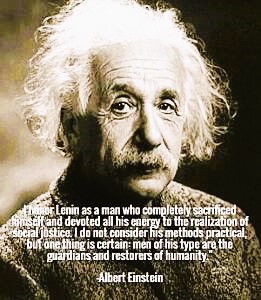
1 The photograph of Albert Einstein captioned with his appraisal of V. I. Lenin (above, left) comes from this webpage entitled, "Albert Einstein on Vladimir Lenin: 'Men of his type are the guardians and restorers of humanity'."
The full quotation reads, "I honor Lenin as a man who completely sacrificed himself and devoted all his energy to the realization of social justice. I do not consider his methods practical, but one thing is certain: men of his type are the guardians and restorers of humanity."
12. OATH OF ALLEGIANCE OF THE WORKERS' AND PEASANTS' RED ARMY.
(February 23, 1939. Pravda, February 25, 1939)
February 23, 1939
I, a citizen of the Union of Soviet Socialist Republics, upon joining the ranks of the Workers' and Peasants' Red Army do hereby take the oath of allegiance and do solemnly vow to be an honest brave disciplined and vigilant warrior, to guard all military and State secrets strictly, to obey implicitly all Army regulations and orders of my commanders, commissars and superiors.
I vow to observe the duties of a soldier conscientiously, to safeguard Army and National property in every way possible and to be true to my People, my Soviet
Motherland and the Workers' and Peasants' Government unto my last breath.
I am always prepared on the command of the Workers' and Peasants' Government to come to the defence of my Motherland—the Union of Soviet Socialist Republics—and, as a warrior of the Workers' and Peasants' Red Army I vow to defend her courageously, skilfully, creditably and honourably without sparing
my blood and my very life to obtain total victory over the enemy.
And if through evil intent I break this solemn oath let the stern punishment of Soviet law and the universal hatred and contempt of the working people fall upon me.1
J. STALIN
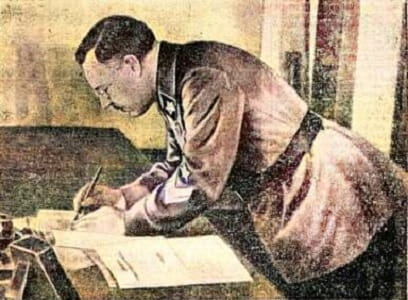
1 The photograph of Marshal Voroshilov signing the oath of allegiance on February 23, 1939 (above, right) comes from this Russian webpage entitled, "OATH." The original B/W was colorized with Lunapic.
13. REPORT OF THE CENTRAL COMMITTEE TO THE EIGHTEENTH CONGRESS OF THE COMMUNIST PARTY.
(March 10, 1939)
Delivered on March 10, 1939
[...]
Certain foreign journalists have been talking drivel to the effect that the purge of Soviet organizations, the eradication of spies, assassins and wreckers like Trotsky, Zinoviev, Kamenev, Yakir, Tukhachevsky, Rosengoltz, Bukharin and other fiends has "shaken" the Soviet system and "demoralized" it. One can only laugh at such cheap drivel.
How can the purging of Soviet organizations, the elimination of noxious and hostile elements, shake and demoralize the Soviet system? Who needs this Trotsky-Bukharin bunch of spies, assassins and wreckers which kow-towed to the outside world, who were possessed by a slavish instinct to grovel before every foreign bigwig and who were ready to enter his service as a spy? Who needs this handful of people who did not understand that the humblest Soviet citizen, once freed from Capital's fetters, stands head and shoulders above any prominent alien bigwig? Who needs this people whose neck wears the yoke of capitalist slavery? Who needs this miserable band of venal slaves? What value can they have for the people, whom can they "demoralize"?
In 1937 Tukhachevsky, Yakir, Uborevich and other fiends were sentenced to be shot. The elections to the Supreme Soviet of the U.S.S.R. took place afterward [in December 1937]. In those elections 98.6% of the votes were cast for the Soviet power.1
At the beginning of 1938 Rosengoltz, Rykov, Bukharin and other fiends were sentenced to be shot. The elections to the Supreme Soviets of the Union of Republics were held afterward [in June 1938]. In these elections 99.4% of the votes were cast for the Soviet power.
Where are the symptoms of "demoralization"? we would like to know. And also why wasn't this "demoralization" reflected in the election results?
Hearing these foreign drivellers one might surmise that if the spies, murderers and wreckers had been left free to wreck, murder and spy without let or hindrance, the Soviet organizations would be far sounder and mightier today.
(Laughter)
Are these gentlemen not giving themselves away prematurely by defending the cause of spies, murderers and wreckers so insolently?
Would it not be fairer to say that the weeding out of spies, assassins and wreckers from our Soviet organizations was bound to lead and led to the strengthening of these organizations?
What, for instance, do the events at Lake Hassan show other than precisely the weeding out of spies and wreckers is the best means of buttressing our Soviet organizations?
[...]
Comrades, I am now about to conclude my report.
I have sketched in broad outline the path traversed by our Party during the period under review. The results of the work of the Party and of its Central Committee during this period are well known. There have been mistakes and shortcomings in our work. The Party and the Central Committee did not conceal them and strove to correct them. There have also been important successes and big achievements which must not be allowed to turn our heads.
The chief conclusion to be drawn is that the working class of our country, having abolished the exploitation of man by man and firmly established the Socialist system, has proven to the world the acumen of its cause. That's the chief conclusion for it strengthens our faith in the power of the working class and in the inevitability of its ultimate victory.
The bourgeoisie of all countries assert that the peoples cannot do without capitalists and landlords, without merchants and kulaks. The working class of our country has proven with its success that people can do without exploiters perfectly well.
The bourgeoisie of all countries assert that after the eradication of the old bourgeois system the working class can not build anything new on its own. The working class of our country has proven with its accomplishments that it is quite capable not only of destroying the old system but of building a new and better one: the Socialist system which knows not economic crises or unemployment.
The bourgeoisie of all countries assert that the peasantry can not walk the path of Socialism. The collective-farm peasants of our country have proven in fact that they can do so and be fruitful.
The chief endeavour of the bourgeoisie and reformer hangers-on of all countries is to dispel from the working class faith in its own might, faith in the possibility and inevitability of its ultimate victory, and thus perpetuate the capitalist slavery—for the bourgeoisie knows very well that if capitalism has not yet been overthrown and continues to exist is not because of its merits but because the proletariat does not yet have enough faith in its eventual triumph.
It cannot be said that the efforts of the bourgeoisie have altogether been fruitless in this regard. It must be conceded that the bourgeoisie and its agents inside the working class have poisoned the minds of the working class to some extent with the toxin of doubt and skepticism.
If the achievements of the working class of our country, its struggle and triumph, serve to rouse the spirit of the working class in capitalist countries and to galvanize its faith in its own power and ultimate victory then our Party may say that its work has not been in vain.
And there need be no doubt that such will be the case.
(Loud and prolonged applause)
Long live our victorious working class!
(Applause)
Long live our victorious collective-farm peasantry!
(Applause)
Long live our Socialist intelligentsia!
(Applause)
Long live the great friendship of the nations of our country!
(Applause)
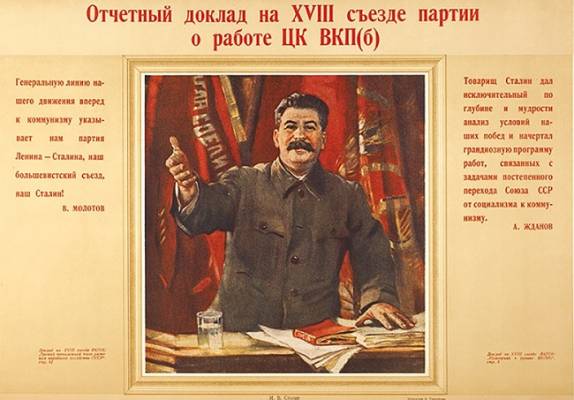
Long live the Communist Party of the Soviet Union! 2
(Applause)
(The delegates rise and hail Comrade Stalin with loud and stormy cheers. Cries of: "Hurrah for Comrade Stalin!" "Hurrah for our great Stalin!" "Hurrah for our beloved Stalin!")
1In those elections 98.6% of the votes were cast for the Soviet power - Recall Item 1, footnote 2.
2 V. Stenberg's 1939 illustration of Stalin at the Eighteenth Party Congress (above, right) comes from this Russian webpage entitled, "Lot 266, Auction #45" of the Litfund Auction House, Moscow.
14. KIROV, ZINOVIEV, BUKHARIN AND STALIN.
(News from Galiciana)
Eight pertinent Russian videos may be watched by clicking on their hyperlink. Seven original videos were clipped and spliced (left column of the table below).
The splicing for the 1934 and 1935 videos was done with BeeCut. The two videos were subsequently reduced in size to enable uploading to the free NEOCITIES host. Compression was performed with FreeConvert.
The splicing for the 1936 through 1940 videos was done with MP4Joiner (MP4 Tools) 3.8 (recommended). This tool obviated the need for MP4 compression.
Wednesday December 5, 1934. El Pueblo Gallego, rotativo gráfico de la mañana (Vigo), page 8.
Leningrad, 2: Soviet police have identified the assassin of Sergei Mironovich Kirov. He is Leonid Nikolaev, thirty years old and a former employee of the Workers and Peasants Inspection department of the Leningrad District.
Stalin, Molotov, Voroshilov and other dignitaries of the Soviets arrived "today" [December 2] to Leningrad to pay their last respects to Kirov, whose mortal remains will be removed to Moscow on Tuesday night [December 4] to be interred in the Red Square mausoleum on December 6. Today, tomorrow and the day after were declared days of official mourning.
The president of the Foreign Affairs Bureau has denied reports circulating abroad to the effect that the assassination of Kirov was the start of a grand conspiracy designed to slay many top Soviet dignitaries. He has also denied the rumours of mass detentions allegedly ordered by the authorities across the entire country to obviate said conspiracy.
Medinov the administrative head of the Commissariat of the Interior and six underlings have all been sacked, accused of negligence over the assassination of Sergei Kirov. For the same reason seventy-five policemen of Leningrad and environs were sacked too.
The Presidency of the Soviet Executive Committee has passed a resolution to carry out immediately the execution of every individual directly or indirectly linked to the assassination of general-secretary Kirov. The Central Executive Committee of the Soviets has published a resolution authorizing the immediate execution of everyone convicted of terrorism. The Committee will not admit appeals in such cases.
Kirov was twenty-six years old, a journalist by profession and an Old Bolshevik. He held the posts of secretary of the Central Committee of the Communist Party and was a member of the Politburo and of the Central Executive Committee of the U.S.S.R. He had succeeded Zinoviev in the Leningrad post. He could be considered Stalin's former lieutenant in Leningrad.
It is believed quite possible that the crime will set off important consequences for Soviet domestic policy.
Wednesday December 19, 1934. El Compostelano, diario independiente (Santiago de Compostela), page 1.
London: The correspondent of The Daily Telegraph informs that following Kirov's assassination eighty-seven persons were sentenced to death by military tribunals: sixty-six were executed on December 5, twelve on December 8 and nine on December 11. Additionally many others were shot by various G.P.U. units.
Meanwhile the correspondent of The Daily Express in Warsaw provides some details of the December 5 executions in Moscow. The sentenced were split into groups of ten and shot with a revolver. Five G.P.U. agents were among those executed.
Before being shot a very young fellow pleaded: "Wait, don't shoot. Take me to Stalin and I'll tell him everything." To which the guards replied, "In a few instants you'll be standing before Ilych, tell him everything." As is known, Ilych was Lenin's middle name.
Friday December 21, 1934. El Eco de Santiago, diario de la tarde (Santiago de Compostela), page 3.
Madrid, 21: London's trade unions have moved a motion expressing horror at the assassination of Kirov but also alarm at the executions underway in retaliation.
Saturday December 22, 1934. El Pueblo Gallego, rotativo gráfico de la mañana (Vigo), page 1.
London: There is much ado surrounding the report received from Moscow that Communist personalities Zinoviev and Kamenev were arrested by order of the Soviets, accused of complicity in the assassination of Kirov.
Sunday December 23, 1934. El Ideal Gallego, decano de la prensa provincial (A Coruña), page 3.
The correspondent of The Daily Express in Warsaw says that Zinoviev and Kamenev will be tried by a tribunal composed of five judges, Stalin himself included, accusing them of complicity in the death of Kirov in Leningrad and soliciting the death penalty, a prearranged verdict seemingly. The accused were taken to Lubyanka Prison.
Meantime Stalin has decided to solicit the expulsion of Trotsky from French territory.
Sunday December 30, 1934. La Región, diario independiente, de intereses generales y avisos (Ourense), page 2.
London: Nikolaiev and another sixteen detainees were shot for being presumably implicated in the assassination of Kirov.
Please note that the news clippings to follow were all subject to Fascist censorship
Thurday August 27, 1936. El Ideal Gallego (A Coruña), page 1.
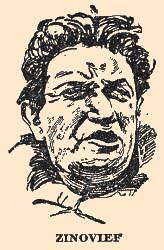
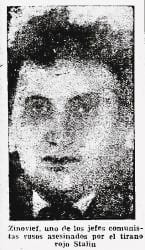
London, 26: Telegraphs from Moscow inform that Zinoviev and Kamenev were executed together with other prominent Soviet leaders.
Zinoviev and Kamenev were Lenin's famous aides since the early days of the communist Russian Revolution and they were lately adherents of the Trotskyist faction.
These executions without due process are one more proof of the terrible oppression endured by the hapless Russian people.
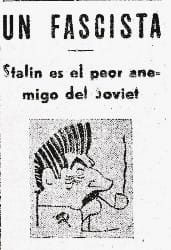
It is also reported tha a terrible campaign has begun across the whole of Russia against Trotskyismt by order of Stalin the tyrant, revealing the presence of a heavy groundswell across Russia which puts Stalin's dictatorship in imminent peril.
The secretary-general of the British trade unions which, as is known, are the workingman organizations of the Labour Party has lamented in a press conference the adoption of these grave measures and declared that Stalin has missed an excellent opportunity to show himself robust and generous.
Monday July 26, 1937. Hoja Oficial del Lunes al servicio de España (Vigo), page 5.
Paris: The strain that dominates Soviet current events is the reign of terror looming over the U.S.S.R. with mounting violence. Enthralled by a death obsession the sinister despot installed in the Kremlin deals blows to the left and to the right with a sole desire: to smother every whiff of resistance to his dictatorial will.
The purges and the executions take place across all fields of the country's activity.
It is no longer a question of exterminating the bourgeoisie ("the class enemy"). Now the triumphant class and the regime's framework are the ones offering victims to the bloodlust of the "father of the peoples." After shooting the regime's founders Stalin continues his work of cleansing. Blood flows like a river.
Here is a sketch of recent victims of his bloodlust:
Among leaders of the Communist Party, aside from the chief ones—Zinoviev, Kamenev, Muralov, Yevdokimov—five thousand people have been executed. Thrice as many were banished to internal exile.
Not even the Supreme Council of the National Economy has been spared. After the execution of Pyatakov came the executions of Smirnov, "Malychev" (?), Lifshitz the aide of Kaganovich, Antonov the Commissar of Transportation and some eighteen thousand bureaucrats of every grade...
[...]
The Red Army has paid an enormous tribute to the terror. It's debatable whether it can still put up a fight. Some two thousand generals and officers of every rank were executed over recent months...
A thousand and five hundred servicemen were arrested. Among them Admiral Viktorov the Commander-in-Chief of the Pacific Fleet, and the generals "Mironov" "Smaquin" "Rakov" "Toporkov" "Palozov" "Kamkov." The accusation is always the same: treason and espionage on behalf of Germany and Japan.
[...]
Determined to create a vacuum of power around himself and to tolerate only interchangeable executioners ready to slay one another, Stalin the leader of the World Revolution embodies a conclusive example of the sanguinary and collective madness engendered by twenty years of Communist dictatorship.
Saturday March 5, 1938. El Pueblo Gallego, diario de Falange Española Tradicionalista y de las J.O.N.S. (Vigo), page 6.
THE BIZARRE ATTITUDE OF THE ACCUSED
Berlin: The second day of the Moscow Trial was characterized by the charges the accused laid on themselves.
The trial created the complete image of burlesque when the Commissar for the Timber Industry accused himself of the most heinous crimes.
Upon interrogation Ivanov declared that he had been an agent of the Tsarist secret police before the War and had perpetrated numerous crimes against the communists.
Bukharin1 declared that he had wanted to kill Molotov years ago and confessed the most tremendous and varied crimes also.
It is believed that they behave thus because they realize they will be sentenced to death regardless.
1 This hyperlinked clip is from this original documentary titled, "Bukharin and the Terror" (BBC, year 1988).
Monday March 7, 1938. Hoja Oficial del Lunes al servicio de España (Vigo), page 2.
THE TERROR IN RUSSIA
Rome:Il Popolo d'Italia publishes an article devoted to the Moscow Trial which the newspaper titles "Fifth Act," i.e., the fifth sensational trial prepared by Stalin to rid himself of his chief foes.
All the Russian personalities who do not submit to the tyrant's will will be executed one way or another.
Russian leaders stated that the current defendants are accused of espionage and of preparing a coup d'état against the Soviet government which would dismember the most important Russo-Soviet territories.
This conglomerate of defendants is dubbed the "White Trotskyist" bloc. The most prominent figure is Bukharin who for ten years held the post of chairman of the Communist International. Bukharin was considered to be one of the top representatives of Lenin's doctrines.
All the defendants have pleaded guilty.
The coarsening of the Russian people has reached such a degree that they may hold no opinion across the breadth of the U.S.S.R. After twenty years of Soviet culture the Russian people have receded to a stage of civilization extant many centuries ago.
Tuesday March 8, 1938. El Pueblo Gallego, diario de Falange Española Tradicionalista y de las J.O.N.S. (Vigo), pages 1 and 6.
STALIN IS THE WORST ENEMY OF THE SOVIET
Rome (page 1): Il Popolo d'Italia publishes an article which may well have been written by Mussolini himself. The article says that Stalin is transforming every day more and more into the best defender of the Fascist regime because he does nothing but eradicate entire hordes of Fascism's foes daily.
Moscow (page 6): The reason why Bolshevik leaders attach so much importance to the Moscow Trial and why they are employing every means to force defendants to confess to deliberate political and economic acts of sabotage is revealed by an editorial published on Sunday by Pravda the official organ of the Party,
Now after the confessions of those evil saboteurs the Soviet comrades can at last understand why their daily salaries were withheld in so many occasions. Now it becomes intelligible at length why some territories of the U.S.S.R. were often without bread for entire days and weeks; why State-run stores stocked boots only during the summer and vast shoes only during the winter. Everybody now realizes why the supply of salt, sugar and lard was insufficient.
These confessions in the official organ about economic hardship, until now always denied, have shocked foreign circles.
ELOQUENT STATISTICS
Salamanca (page 6): What has befallen the members of the political Directory of the Communist Party who staged the October Revolution of 1917:
Lenin, died in 1924; his embalmed body rests inside a glass case at Moscow's Red Square.
Stalin the secretary-general of the Communist Party is the sole survivor.
Wednesday March 9, 1938. El Pueblo Gallego, diario de Falange Española Tradicionalista y de las J.O.N.S. (Vigo), page 5.
Moscow: In the Moscow Trial session against the Trotskyists yesterday afternoon/evening the contest between the right and left wings of the Communist Party during the initial years of the Soviet regime was brought to light more clearly.
Bukharin attempted to defend himself against the charges vented by some of his comrades to the effect that he had planned the downfall of Lenin and the assassination of Stalin in 1918, but his address was cut short by the State prosecutor.
Four witnesses were called to reinforce the charges aired against Bukharin. All four effortlessly recalled their conversations with Bukharin despite a lag of over twenty years.
Berlin: French newspaper Le Figaro says in relation to the Moscow Trial, "This trial is verily waxing more and more scandalous."
London's press also covers the Moscow Trial. The special correspondent of The Times states that Bukharin has waged a vigorous struggle against a triple supremacy composed of the president of the Tribunal, the Prosecutor General and an acrimonious auditorium.
Wednesday March 9, 1938. La Región, diario independiente, de intereses generales y avisos (Ourense), page 1.
THEY RISE UP AGAINST STALIN
It's not just the French Socialist press, it's Vandervelde in Belgium, it's the trade unions of Sweden, Norway, Denmark, Finland, Estonia and Lithuania refusing to form a united front with the Russians.
It`s a new crisis of Marxism—our topic of a few days ago—without this circumstance making us too happy because, between the fiercest and the most humane, we choose neither. Furthermore we said then and repeat here that we mistrust a humane marxism far more because Marxism is only susceptible of a superficial humanism.
Even those protests are somewhat suspicious. Are the protests about Rakovsky and Bukharin being forced to confess to crimes they haven't committed or are the protests a cue of horror felt at the possibility that such figures may have betrayed the Bolshevik cause? That's what is interesting here.
Sunday March 13, 1938. La Región, diario independiente, de intereses generales y avisos (Ourense), page 2.
THE MOSCOW TRIAL OF THE TWENTY-ONE 19 OF THE 21 DEFENDANTS SENTENCED TO DEATH
Moscow, 12: The prosecutor solicited capital punishment for nineteen defendants and twenty-five years of jail time for the remaining two.
The accusations were levelled mainly against Bukharin and Yagoda. The prosecutor qualified Yagoda as an individual who always cleaves to a political party that holds power.
Saturday May 21, 1938. El Pueblo Gallego, diario de Falange Española Tradicionalista y de las J.O.N.S. (Vigo), page 6.
"CLEANUP" OF SOVIET INDUSTRY PERSONNEL
Moscow: During a conference of Soviet University bureaucrats Molotov the chairman of the Council of People's Commissars delivered a speech dwelling on the purge performed in recent months.
Molotov declared that a large number of enemies of the State had been uncovered in Soviet industry, warranting the elimination of a series of bureaucrats, engineers and specialists, among them Rykov, Bukharin and other Trotskyists.
Molotov ended his delivery by referring to the remains of the bourgeois capitalist class which had been sent to "where History will very soon send the remainder of capitalist society."
Saturday July 30, 1938. El Pueblo Gallego, diario de Falange Española Tradicionalista y de las J.O.N.S. (Vigo), page 12.
CLEANING UP
Sultan Segizbayev the Chairman of the Council of People's Commissars of Uzbekistan, successor to Xo'jayev who a short time ago was shot together with Bukharin, has just been denounced by Moscow's Pravda as "the ferocious enemy of the Uzbek people and of the entire Soviet population."
The same newspaper denounces Aitmetov the former Commissar of Agriculture in equal fashion.
The cleanup proceeds on its course and there is little chore left to do. Soon there will be no one from the Old Bolshevik Guard left in the whole of Russia except Stalin. Somebody will shoot Stalin and the mopping will be done.
Friday February 24, 1939. El Ideal Gallego (A Coruña), page 1.
THE SOVIET ARMY TAKES A NEW OATH
Moscow, 23: Stalin has compelled the entire Red Army to suscribe a new oath, Every officer and soldier will have not only to say it but attest in writing his loyalty to the Red Czar.
Marshall Voroshilov the Commissar of War signed and took the oath today in Moscow in front of other commanders.
Thursday August 3, 1939. El Ideal Gallego (A Coruña), page 1.
Riga, 2: A mammoth trial is scheduled in Moscow for the end of August against thirty-two Soviet officers and ninety bureaucrats based in the Far East who were recently arrested for having criticized Stalin's policy in the Sino-Russian dispute. This will be the first big trial orchestrated by Pankratyev the new Prosecutor-General of the U.S.S.R.—(STEFANI).
Thursday August 24, 1939. El Ideal Gallego (A Coruña), page 3.
Berlin, 24 (4:30 AM): The Reich's Minister of Foreign Affairs, von Ribbentrop, held talks which lasted three hours yesterday afternoon with Messrs. Stalin and Molotov in the presence of the German ambassador based in Moscow. The Reich's minister returned to the Kremlin yesterday evening at 10:00 PM. The negotiations concluded with agreement on a Non-Aggression Pact between Germany and the U.S.S.R. The pact was signed by Molotov and von Ribbentrop in the presence of Stalin and the German ambassador.
Thursday September 21, 1939. El Pueblo Gallego, diario de Falange Española Tradicionalista y de las J.O.N.S. (Vigo), page 5.
Paris: The Parisian press lambasts the intervention of the U.S.S.R. in the Polish war. Léon Blum states in Le Populaire that Stalin has undeniably proceeded like an enemy of everything we love, of everything we believe in and of everything we fight for: the liberty of men and peoples, Justice, Socialism and Peace.
Wednesday September 27, 1939. El Pueblo Gallego, diario de Falange Española Tradicionalista y de las J.O.N.S. (Vigo), page 6.
Moscow, 26: It's been announced that von Ribbentrop the Reich's Minister of Foreign Affairs will visit this city tomorrow invited by Stalin to discuss the unfolding of events in Poland.
Thursday November 30, 1939. El Ideal Gallego (A Coruña), page 5.
FINLAND INVADED BY SOVIET TROOPS
Europe faces a new and brutal threat of the Soviets.
A country of 180 million inhabitants goes to war with another that does not reach four million. Why? Simply because the U.S.S.R. has not renounced its goal of a World Revolution. Those who spoke about a new Russian "nationalism" shut their eyes to reality. Stalin is a follower of Lenin. And the U.S.S.R. is the number-one enemy of civilization.
Presently it's Finland's turn, the Red troops are at the gates. Will Europe watch indifferent the demise of a noble nation? Will the new lunge of communism toward the West not awaken in the conscience of the rest of nations their sense of responsibility? Finland does not want to submit to Red demands, for so doing would mean the loss of national independence and freedom. Moscow threatens. Bombs and cannons have started to talk while Old Europe squanders its energy in civil unrest.
Poland was the first one. A half of this great nation is today the scenario of the worst Bolshevik abuses, the kind of abuses which Spaniards who dwelled in the Red zone are perfectly acquainted with.
Afterward came the turn of the three Baltic nations, Lithuania, Latvia and Estonia. These had to let Red troops occupy strategic points of their territory and accept a mediation which is in effect the negation of their liberty and independence. The occurrence of some incident, which the Russians will use to advantage, and the disappearance of said nations will be a matter of few hours or days if Old Europe, which seems to have abandoned its role of defender of civilization, does not intervene.
Presently, we repeat, it's Finland's turn. The brutal act of the U.S.S.R. is something that should rouse all decent countries of the world to their feet.
Thursday March 14, 1940. El Correo Gallego, decano de la provincia y segundo de Galicia (Santiago de Compostela), page 1.
Copenhaguen, 13: A Danish paper publishes the news that "the head of the Finnish Government" established by the Soviets in Terijoki [today Zelenogorsk] at the beginning of the war has been executed on Moscow's orders for having delivered false reports to the Kremlin. The execution was ordered by Stalin.—Efe.
Thursday March 28, 1940. El Pueblo Gallego, diario de Falange Española Tradicionalista y de las J.O.N.S. (Vigo), page 4.
Paris, 27: It is said in French political circles that a telegram sent by Souritz the Soviet Ambassador in Paris to Stalin, bearing on the signature of the peace treaty between the U.S.S.R. and Finland, is a principal cause for the present friction between the countries. They point out that said telegram contained expressions which are truly inadmissible for France and that it amounted to anti-French propaganda (Efe).
Tuesday April 2, 1940. El Pueblo Gallego, diario de Falange Española Tradicionalista y de las J.O.N.S. (Vigo), page 4.
London, 1: The diplomatic editor of The Daily Herald writes, "Stalin prepares a new offensive—diplomatic this time—whose goal is the annexation of the Romanian Bessarabia."
This is the conclusion reached by several diplomats after studying Molotov's speech and particular declarations of Soviet diplomats. Stalin's general objective is clear enough. The dictator esteems that all the territory lost by Russia during the Revolution was stolen in her days of frailty and now that he deems Russia strong he intends to regain them.—(Efe).
Monday May 20, 1940. Hoja Oficial del Lunes al servicio de España (Vigo), page 6.
No political negotiation has produced as many anecdotes as the Russo-Finnish talks held in Moscow and which wound up so regrettably. It is said that Stalin upon meeting unexpected resistance from the Finnish delegation queried Paasiviki in amazement,
"Tell me, Mr. Paasiviki, how many soldiers do you have guarding the frontier?"
Paasiviki gave him an approximate number.
Stalin started to smile and quipped, "We got twice as many."
Then Paasiviki whispered, as if talking to himself, "We'll have to tell our marshal to distribute twice as many bullets to every soldier."