straightaway THE TASKS OF BUSINESS EXECUTIVES. February 4, 1931.
straightaway NEW CONDITIONS — NEW TASKS IN ECONOMIC CONSTRUCTION. June 23, 1931.
straightaway TALK WITH THE GERMAN AUTHOR EMIL LUDWIG. December 13, 1931.
straightaway MAGNITOGORSK IRON AND STEEL WORKS PROJECT, MAGNITOGORSK. March 30, 1932.
straightaway MAGNITOGORSK: SOVIET FILM CLIP & DEMETRA. Years 1932 and 2013.
straightaway TO THE BUILDERS OF THE DNIEPER HYDRO-ELECTRIC POWER STATION. October 10, 1932.
straightaway THE FIFTEENTH ANNIVERSARY OF THE OGPU. December 20, 1932.
straightaway JOINT PLENUM OF THE CENTRAL COMMITTEE AND CENTRAL CONTROL COMMISSION. January 7, 1933.
straightaway REPORT OF THE CENTRAL COMMITTEE TO THE SEVENTEENTH PARTY CONGRESS. January 26, 1934.
straightaway INSTEAD OF A REPLY TO THE DISCUSSION. January 31, 1934.
straightaway News from Galiciana: KERENSKY'S TWO LECTURES IN MADRID.
1. REPLY TO THE DISCUSSION ON THE POLITICAL REPORT OF THE CENTRAL COMMITTEE TO THE SIXTEENTH CONGRESS OF THE COMMUNIST PARTY.1
(July 2, 1930. Pravda, 181, July 3, 1930)
July 2, 1930
[...]
Allow me to pass now to the utterances of the former leaders of the Right opposition.
What does the congress demand of the former leaders of the Right opposition? Repentance perhaps, or self-chastisement? Of course not! Our Party, the congress of our Party, will never go to the length of requiring Party members to do anything that might humiliate them. The congress demands three things of the former leaders of the Right opposition:
Firstly that they realize that there is a gulf between the line of the Party and the line they were advocating and that the line they upheld leads objectively not to
the victory of socialism but to the victory of capitalism.
(Voices: "Quite right!")
Secondly that they brand that line as anti-Leninist and dissociate themselves from it frankly and honestly.
(Voices: "Quite right!")
Thirdly that they fall into step with us and together with us wage a determined struggle against all Right deviators.
(Voices: "Quite right!" Stormy applause)
That's what the congress demands of the former leaders of the Right opposition.
Is there anything humiliating in these demands for them as people wanting to remain Bolsheviks?
Obviously there is nothing here that is or could be humiliating. Every Bolshevik, every revolutionary, every self-respecting Party member will realize that he can only stand higher and gain respect in the eyes of the Party if he frankly and honestly admits facts that are clear and indisputable.
That's why I think Tomsky's talk about people wanting to send him to the Gobi Desert to eat locusts and wild honey is on a par with the flat jokes of a provincial variety theatre and has nothing in common with a revolutionary's self-esteem.
(Laughter. Applause)
It may be asked: why is the congress once again making these demands of the former leaders of the Right opposition?
Is it not a fact that these demands were presented to them once before, in November 1929, at the plenum of the Central Committee? 2 Is it not a fact that the former leaders of the Right opposition accepted those demands at that time, renounced their own line, admitted its error, recognized the correctness of the Party line and promised to fight together with the Party against the Right deviation? Yes, all that was so. What is the point then? The point is that they did not keep their promise, they did not fulfil and are not fulfilling the pledges they gave seven months ago.
(Voices: "Quite right!")
Uglanov was quite right when he said in his speech that they had not kept the pledges given to the November plenum of the Central Committee.
That's the source of the distrust manifested at this congress.
That's why the congress is once more presenting its demands to them.
Rykov, Tomsky and Uglanov complained here that the congress was treating them with distrust. But whose fault is that? It's their own fault. Anyone who fails to keep his pledges cannot expect to be trusted.
Did they, the former leaders of the Right opposition, have any opportunities, any occasions to follow through with their promises and turn over a new leaf? Of course they did. And what advantage did they take of these opportunities and occasions during the seven months? None.
Recently Rykov attended the conference in the Urals.3 Consequently he had an excellent chance to correct his mistakes. What happened? Instead of frankly and resolutely cease wavering he began to play tricks and manoeuvre. Naturally the Urals Conference had to rebuff him.
Now compare Rykov's speech at the Urals Conference with his speech at the Sixteenth Congress. A gulf lies between them. There he played tricks and manoeuvred, fighting the conference. Here he tries frankly and publicly to admit his mistakes, tries to break with the Right opposition and promises to support the Party in the struggle against deviations. Whence such a change and how is it to be explained? It is to be explained obviously by the precarious standing of the former leaders of the Right opposition in the Party. No wonder the congress has this impression: you'll get nothing out of these people unless you put the screw on them.
(General laughter. Prolonged applause)
Did Uglanov have an opportunity of fulfilling the promise he made to the November plenum of the Central Committee? Yes, he did. I have in mind his address to the non-Party meeting at the Moscow Electric Works. What happened? Instead of speaking there as befits a Bolshevik he began to find fault with the Party line. He was of course suitably rebuffed by the Party cell of the Works.
Now compare that speech with his statement printed in today's Pravda. A gulf lies between them. How is this change to be explained? Again by the precarious standing of the former leaders of the Right opposition. Small wonder then that the congress has drawn this definite lesson: you'll get nothing out of these people unless you put the screw on them.
(General laughter. Applause)
Or Tomsky for instance. Recently he was at the Transcaucasian Conference in Tiflis.4 Consequently he had a chance to make amends for his sins. And what
happened? He dealt in his speech with state farms, collective farms, co-operatives, the cultural revolution and all that sort of thing, but he did not utter a word about the chief thing: his opportunist work in the All-Union Central Council of Trade Unions. And that's called fulfilling pledges given to the Party? He wanted to outwit the Party without realizing that millions of eyes are watching us all. In this matter you cannot outwit anybody.
Now compare his Tiflis speech with the one he delivered at this congress, where he directly and openly admitted his opportunist mistakes in his leadership of the
A.U.C.C.T.U. A gulf lies between them. How is this difference to be explained? Again, by the precarious status of the former leaders of the Right opposition. Small wonder the congress has tried to exert due pressure on these comrades to have them carry out their obligations.
(Applause. General laughter throughout the hall)
That's the source of the mistrust the congress still entertains toward these comrades.
How is this more-than-strange conduct of the former leaders of the Right opposition to be explained?
Why in the recent past did they not make a single attempt to keep their pledges voluntarily, without pressure from outside?
At least two circumstances explain why:
Firstly, not fully convinced that the Party line was right, they continued to carry on a certain factional activity surreptitiously, lying low for the time being, awaiting a suitable occasion to come out openly against the Party once more. When they held factional meetings and discussed Party issues they reasoned thus: let us wait until the spring—perhaps the Party will come a cropper with the sowing and then we'll strike and strike hard. The spring gave them no advantage, however, because the sowing proceeded smoothly. Then they speculated afresh: let us wait until the autumn—perhaps the Party will come a cropper with the grain procurements, then we'll strike at the Central Committee. But the autumn, too, disappointed them, giving them nothing for their pains. And as spring and autumn recur every year, the former leaders of the Right opposition continued to bide their time, repeatedly pinning their hopes now on the spring and now on the
autumn.
(General laughter throughout the hall)
Naturally they could not keep their pledges because they kept waiting for a favourable moment to strike at the Party from season to season.
Lastly the second reason. The former leaders of the Right opposition do not understand or believe our Bolshevik rates of development and will not in general accept anything beyond the scope of a gradual development, beyond the bounds of letting matters run their own course. Moreover our Bolshevik speeds, our new methods of reconstruction, the sharpening of the class struggle and its consequences, fill them with alarm, confusion, fear and terror. Hence it's natural for them to shrink away from the most incisive slogans of our Party.
They are afflicted with the same disease as Belikov the teacher of Greek and Chekhov's well-known character from "The Man Wrapped in Padding";—do you remember Chekhov's story, "The Man Wrapped in Padding"? You may recall that Belikov always went about wearing galoshes, a padded coat and carrying an umbrella in hot or cold weather. "Pardon me, why do you wear galoshes and padded coat in July's hot weather?" Belikov would reply, "You can never tell, something untoward might happen; a sudden frost might set in, what then?"
(General laughter. Applause)
He feared every novelty like the plague, everything outside the daily routine of his drab philistine life. If a new restaurant opened, Belikov took alarm: "It may of course be a grand idea to open a restaurant but take care, something untoward might happen!" If a drama circle or a reading room was started, Belikov again panicked, "Why a drama circle, why a new reading room? Take care, something untoward might happen!"
(General laughter)
The same thing can be said about the former leaders of the Right opposition. Do you remember the transfer of technical colleges to the People's Commissariats concerned with economic matters? We wanted to transfer two technical colleges only to the Supreme Council of the National Economy. A small matter, it would seem. Yet we met stiff resistance from the Right deviators. "Hand over two technical colleges to the Supreme Council of the National Economy? Why? Isn't it better to wait awhile? Take care, something untoward might happen!" Yet today all our technical colleges have been transferred and we are doing alright.
Or take for example the emergency measures drawn up against the kulaks. Do you remember the hysterics of the Right opposition leaders? "Emergency measures against the kulaks? Why? Would it not be better to adopt a liberal policy toward them? Take care, something untoward might happen!" Yet today we are carrying out the policy of eliminating the kulaks as a class, a policy that makes the emergency measures look innocuous, and we are doing alright.
Or for example the creation of collective farms and state farms. "State farms and collective farms? What are they for? Why hurry? Mind you, something might happen as a result of these state and collective farms."
And so on and so forth.
This dread of novelty, this inability to tackle new problems in a new way, the apprehension that "something untoward might happen", is what prevents the former leaders of the Right opposition from clicking with the Party.
These traits of the man wrapped in padding assume particularly ridiculous heights with them when difficulties arise, when the tiniest cloud appears on the horizon. As soon as any difficulty or hitch happens anywhere in our country they become alarmed, fearing that something untoward might happen.
Should a cockroach make a rustling sound somewhere, they start back terror-stricken even before it has had time to crawl out of its hole and they begin to howl about a catastrophe, about the downfall of the Soviet regime.
(Loud laughter)
We try to calm them, to convince them that as yet nothing dangerous has occurred, that it's only a cockroach after all, which no one need be afraid of. But to no avail. They keep howling, "What do you mean, a cockroach? That's not a cockroach, it's a thousand wild beasts! It's not a cockroach, it's the abyss, the downfall of the Soviet regime..." And a regular commotion breaks out. Bukharin writes theses on the subject and sends them to the Central Committee, asserting that its policy has brought the country to ruin and that the Soviet regime will certainly perish in a month's time at the very most. Rykov backs Bukharin's theses with one reservation, a crucial disagreement, namely, that the Soviet regime will perish not in a month's time but after one month and two days...
(General laughter)
Tomsky joins Bukharin and Rykov but censures their obsession with theses, documents they will have to answer for later on: "How many times have I told you, 'do as you please but don't leave any evidence behind, don't leave any clues!'"
(Roars of laughter throughout the hall. Prolonged applause)
True, later on, when a year has lapsed and every fool can see that the cockroach menace was not worth a rap, the Right deviators come to and in finer fettle are not averse to even boast a little, that they are not afraid of cockroaches, and anyway that one was frail and puny.
(Laughter. Applause)
But that's after a year has passed. In the meantime, be good enough to put up with these procrastinators.
These, comrades, are the reasons that bar the former leaders of the Right opposition from drawing closer to the Party core and blending in.
How can the clog be cleared?
There is only one way: they must once and for all break with their past, renew themselves and meld completely with the Central Committee of our Party in its endeavour for Bolshevik rates of growth, in its struggle against the Right deviation.
There is no other way.
If the former leaders of the Right opposition can do this, well and good. If not, they will have nobody but themselves to blame.
(Prolonged applause from the entire hall. An ovation. All rise and sing the "Internationale")
1 The Sixteenth Congress of the Communist Party was held in Moscow between June 26-July 13, 1930. The congress discussed the political and organizational reports of the Party's Central Committee; the reports of the Central Auditing Commission, Central Control Commission and of the Communist Party delegation to the Executive Committee of the Comintern; and reports on the fulfilment of the Five-Year Plan in industry, on the collective-farm movement and the promotion of agriculture, and on the tasks of the trade unions in the reconstruction period.
The congress unanimously approved the political line and activities of the Central Committee of the Party and instructed it to continue ensuring Bolshevik rates of socialist construction, to achieve fulfilment of the Five-Year Plan in four years and to carry out the sweeping socialist offensive along the whole front unswervingly with the elimination of the kulaks as a class on the basis of complete collectivization. The congress noted the momentous importance of the crucial change in the development of agriculture, thanks to which the collective-farm peasantry had become a real and stable pillar of the Soviet regime.
The congress instructed the Party's Central Committee to continue pursuing a firm policy of peace but to strengthen the defence capacity of the U.S.S.R.
The congress issued directives that heavy industry be developed to the utmost, that a new powerful coal and metallurgical base be created in the eastern part of the country, that the work of all mass organizations be reconstructed, the role of the trade unions in socialist construction be increased and that all workers and toiling masses be drawn into the socialist emulation movement.
The congress completely exposed the Right opportunists as agents of the kulaks within the Party and declared that the views of the Right opposition were incompatible with membership of the Communist Party. The congress instructed the Party organizations to intensify the fight against deviations on the national question, against dominant-nation chauvinism and local nationalism, adopting a conciliatiry attitude towards them but firmly carrying out the Leninist national policy for the manifold cultures of the peoples of the U.S.S.R., i.e., national in form, socialist in content.
The Sixteenth Congress is known in the history of the Party as the "congress of the sweeping offensive of socialism along the whole front, of the elimination of the kulaks as a class, and of the realization of complete collectivization."
J. V. Stalin delivered the political report of the Central Committee on June 27 (see Works, 12, pp. 242-385) and replied to the discussion on the report on July 2.
2Is it not a fact that these demands were presented to them once before, in November 1929, at the plenum of the Central Committee? - The plenum of the Central Committee held on November 10-17, 1929, discussed the following questions: control figures for the national economy between 1929-30; results and further tasks of collective farms, etc. After reviewing the question of the group of Right deviators, the plenum declared that propaganda of the views of Right opportunism and of conciliation towards it were incompatible with membership in the Communist Party, decided to expel Bukharin—ring-leader of the Right-wing capitulators—from the Poliburo and issued a warning to Rykov, Tomsky and other members of the Right opposition.
3Recently Rykov attended the conference in the Urals - The Tenth Urals Party Conference took place at Sverdlovsk between June 3-13, 1930. The conference fully approved the political and organizational line of the Central Committee. After exposing the Right-opportunist manoeuvres of Rykov and emphasizing the counter-revolutionary treacherous role of the Right deviation in the communist movement, the conference called upon the Urals Party to wage a relentless fight against all attempts of Right capitulators to obstruct the line of the Leninist Central Committee of the Soviet Communist Party.
4Or Tomsky for instance. Recently he was at the Transcaucasian Conference in Tiflis - This refers to the Sixth Congress of the Communist Organizations of Transcaucasia (Azerbaijan, Armenia, and Georgia) which took place in Tiflis between June 5-12, 1930. The congress fully approved the political and organizational line and the practical work of the Central Committee of the Communist Party.
2. ANTI-SEMITISM.
(January 12, 1931. Pravda, 329, November 30, 1936)
Reply to an Inquiry of the Jewish News Agency in the United States
In answer to your inquiry:
National and racial chauvinism is a vestige of the misanthropic customs characteristic of the period of cannibalism. Anti-semitism, as an extreme form of racial chauvinism, is the most dangerous vestige of cannibalism.
Anti-semitism is of advantage to the exploiters as a lightning conductor that deflects the blows aimed at capitalism by the working people. Anti-semitism is dangerous for the working people, being a false path that leads them off the right road and lands them in the jungle. Hence Communists, as consistent internationalists, cannot but be irreconcilable, sworn enemies of anti-semitism.
Anti-semitism in the U.S.S.R. is punishable with the utmost severity of the law as a phenomenon deeply hostile to the Soviet system. Under U.S.S.R. law active anti-semites are liable to the death penalty.1
1 The following extract comes from Leon Trotsky's article entitled, "Thermidor and Anti-Semitism," written in 1937.
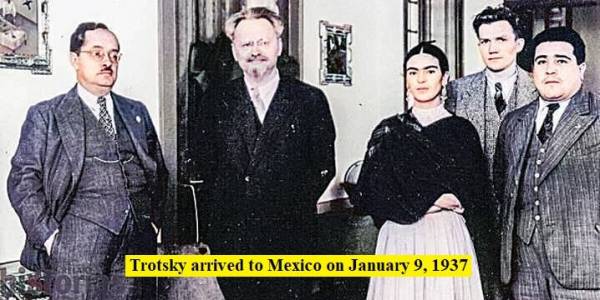
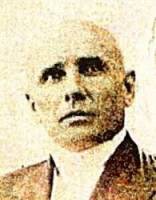
The accompanying photograph of Leon Trotsky, Frida Kahlo and others (below, left) comes from this Mexican webpage entitled, "Leon Trotsky the political exile," and was colorized with Lunapic.
Thermidor and Anti-Semitism (extract)
At the time of the last Moscow trial I remarked in one of my statements that Stalin exploited the anti-Semitic tendencies of the country in his struggle with the Opposition. I received a series of letters on this subject and questions which were by and large very naive (there is no reason to hide the truth). "How can one accuse the Soviet Union of anti-Semitism?" or "If the U.S.S.R. is an anti-Semitic country, is there anything left at all?" That was the dominant tone. These people raise objections and are perplexed because they routinely counterpose Fascist anti-Semitism with the emancipation of the Jews accomplished by the October Revolution. To these people it now appears that I am wresting a magic charm from their hands. Such a method of reasoning is typical of those who are accustomed to vulgar non-dialectical thinking. They live in a world of immutable abstractions. They recognize only what suits them: Hitler's Germany is the absolutist kingdom of anti-Semitism; the U.S.S.R., on the contrary, is the kingdom of national harmony. Vital contradictions, mutations, transitions from one phase to another—in a word, the actual historical processes—escape their lackadaisical attention.
It has not yet been forgotten, I trust, that anti-Semitism was quite widespread in Czarist Russia among peasants, the urban petty bourgeoisie, the intelligentsia and the more backward strata of the working class. "Mother" Russia was renowned not only for her periodic Jewish pogroms but also for a considerable number of anti-Semitic publications which, in their day, enjoyed a wide circulation. The October Revolution abolished the outlaw status of the Jews. However that does not at all mean that it swept away anti-Semitism in one sweep. A lengthy and persistent struggle against religion has failed to stop suppliants even today from crowding thousands and thousands of churches, mosques and synagogues. The same situation prevails in the sphere of national prejudices. Legislation alone does not change people. Their thoughts, emotions, outlook, depend upon tradition, material conditions of life, cultural level, etc. The Soviet regime is not yet twenty years old. The older half of the population was educated under Czarism. The younger half has inherited a great deal from the older. These general historical conditions should by themselves make any thinking person realize that despite the model legislation of the October Revolution it's impossible to maintain that national and chauvinist prejudices, particularly anti-Semitism, do not persist assiduously among the backward ranks of the population.
[...]
He who observes Soviet life attentively, even if only through official publications, will from time to time see bared in various parts of the country hideous bureaucratic abscesses: bribery, corruption, embezzlement, murder of individuals whose existence the bureaucracy finds embarassing, rapes and the like. Then Moscow is constrained to resort to demonstration trials. In these the Jews inevitably comprise a significant percentage because—as we already stated—they make up a large percentage of the bureaucracy and because the top bureaucratic layer in the capital or provinces, impelled by self-preservation, strives to divert the wrath of the toiling masses away from itself toward Jewish cadres who are stained with the same widespread odium of peasants and workers toward the bureaucracy. This fact was known to every critical observer of the U.S.S.R. as far back as ten years ago when Stalin's regime had hardly displayed its basic features.
The struggle against the Opposition was a matter of life and death for the ruling clique. Program, principles, ties with the masses, everything was rooted out and discarded because of the new ruling clique's anxiety for its self-preservation. These people stop at nothing in order to keep their privileges and power.
Recently the news was broadcast to the whole world that my youngest son, Sergei Sedov, was indicted for plotting a mass poisoning of workers.
Every normal person will conclude that people capable of proferring such a charge have reached the last degree of moral degradation. Is it possible then to doubt even for a moment that these same accusers are capable of arousing the anti-Semitic prejudices of the masses? Degradation and incitement melded in the indictment of my son.
It's worthwhile pausing to study the case. From the day of their birth my sons bore their mother's surname (Sedov). They never used any other surname—neither at elementary school nor university nor later in life. As for me, I have borne the surname "Trotsky" for the past thirty-four years. During the Soviet era no one ever called me by my father's surname (Bronstein) just as no one ever called Stalin by his (Dzhugashvili). In order to obviate my sons changing their name I took my wife's surname for the requisites of "citizenship" (according to Soviet law this is fully permissible). However after my son Sergei Sedov was charged with the utterly incredible crime of plotting to poison the workers, the G.P.U. announced in the Soviet and foreign press that the "real" (!) surname of my son is not Sedov but Bronstein. If these falsifiers wished to emphasize the connection of the accused with me, they would have called him "Trotsky" since the surname Bronstein means nothing at all to anyone politically. But they were playing another game: they wished to emphasize my Jewish origin and the semi-Jewish origin of my son. I paused at this episode because it has a vital though not exceptional character. The whole struggle against the Opposition is replete with such nuances.
While Stalin, Zinoviev and Kamenev worked together as a "Troika" between 1923 and 1926, the plucking on the strings of anti-Semitism bore a very cautious and veiled character. Especially-trained orators (Stalin was already attacking his associates covertly) said that Trotsky's followers were petty bourgeois from "small towns" without defining their race. Actually that was untrue. The percentage of Jewish intellectuals in the Opposition was no greater than their proportion in the Party or in the bureaucracy. Suffice it to name the leaders of the Opposition for the years 1923-25: I. N. Smirnov, Serebryakov, Rakovsky, Piatakov, Preobrazhensky, Krestinsky, Muralov, Beloborodov, Mrachkovsky, V. Yakovlev, Sapronov, V. M. Smirnov, Ishtchenko—fully indigenous Russians. Radek then sympathized halfway only. But at the time of the expulsions of the Opposition from the Party, the bureaucracy purposely emphasized the names of Jewish members of casual or secondary importance just as it did in the trials of grafters and other scoundrels. This was discussed in the Party quite openly and, back in 1925, the Opposition took this emphasis to be an unmistakable symptom of the decay of the ruling clique.
After Zinoviev and Kamenev joined the Opposition the situation changed radically for the worse. At this point a door opened wide to tell the workers that three "dissatisfied Jewish intellectuals" stood at the head of the Opposition. Under Stalin's aegis, Uglanov in Moscow and Kirov in Leningrad implemented this line systematically and almost completely aboveboard. In order to stress to the workers the differences between the "old" and the "new" course, the Jews, even if unreservedly devoted to the general line, were removed from responsible Party and Soviet posts. Not only in the countryside but even in Moscow factories baiting the Opposition often took on an obvious anti-Semitic tack back in 1926. Many agitators brazenly said, "The Jews are rioting." I received hundreds of letters deploring the anti-Semitic slurs used in the struggle against the Opposition. At a Politburo session I handed Bukharin a note: "You cannot help knowing that even in Moscow the tactics of the Black Hundred tactics (anti-Semitism, etc.) are being used in the struggle against the Opposition." Bukharin answered me evasively on the same piece of paper: "Individual instances are of course possible." I replied: "I do not have in mind individual instances but a systematic agitation among Party secretaries in big Moscow enterprises. Will you agree to come with me to investigate an example of this at the factory 'Skorokhod' (I know a number of similar examples)." Bukharin answered, "All right, we can go." I tried in vain to make him keep his promise. Stalin most categorically forbade him to do so. In the months running up to the expulsions of the Opposition from the Party, the arrests, the banishments to internal exile (in the second half of 1927), the anti-Semitic agitation assumed an unbridled character. The slogan, "Beat the Opposition," often took on the hue of the old slogan, "Beat the Jews and save Russia." The matter went so far that Stalin was compelled to come out with a printed statement declaring: "We do not fight against Trotsky, Zinoviev and Kamenev because they are Jews but because they are Oppositionists," etc. To every politically savvy person it was completely clear that this deliberately equivocal targeting of anti-Semitism "excesses" did at the same time, with full intent, nourish it. "Do not forget that the leaders of the Opposition are ... Jews." That was the meaning of Stalin's statement published in all Soviet journals.
When the Opposition proceeded to wage a more decisive and open fight against the repressions, Stalin, in the form of a very significant "jest", told Piatakov and Preobrazhensky: "At least you are fighting against the Central Executive honestly, brandishing your axes. That proves your 'orthodox' approach. Trotsky works slyly without a hatchet." Preobrazhensky and Piatakov related this conversation to me with deep revulsion. Dozens of times Stalin attempted to counterpose the "orthodox" core of the Opposition to my person.
The well-known German radical journalist Franz Pfemfert the former editor of Aktion, at present in exile, wrote to me in August 1936,
Perhaps you remember that several years ago I declared in Aktion that many acts of Stalin can be explained by his anti-Semitic tendencies. The fact that he, through Tass, managed to "correct" the names of Zinoviev and Kamenev in this monstrous trial represents by itself a gesture typical of Streicher. Thereby Stalin gave the "Go" signal to all anti-Semitic, unscrupulous elements.
In fact the surnames "Zinoviev" and "Kamenev" are, it would seem, more famous than the surnames "Radomislyski" and "Rozenfeld".
What other motives could Stalin have had to make the "real" names of his victims known other than to play with anti-Semitic inclinations? Such a ruse without the slightest legal justification was likewise employed over my son's surname, as we have seen.
But the most astonishing act undoubtedly is that all four "terrorists" allegedly sent by me from abroad turned out to be Jews and at the same time agents of the anti-Semitic Gestapo! Inasmuch as I have ever seen any one of these unfortunates, it's clear that the G.P.U. selected them for their racial origin. And the G.P.U. does not operate by virtue of its own inspiration!
Again, if such methods are practiced at the very top where the personal responsibility of Stalin is absolutely incontrovertible, it's not hard to imagine then what transpires at factories and especially in the kolkhozes.
How could it be otherwise? The physical extermination of the older generation of Bolsheviks is for every thinking person an irrefutable symptom of a Thermidorian reaction at its most advanced stage. History has never yet witnessed an instance where the reaction following a revolutionary upsurge was not accompanied by the most unbridled chauvinistic passions, anti-Semitism among them.
3. THE TASKS OF BUSINESS EXECUTIVES.
(February 4, 1931. Pravda, 35, February 5, 1931)
Speech Delivered at the First All-Union Conference of Leading Personnel of Socialist Industry1
February 4, 1931
Comrades, the deliberations of your conference are drawing to a close. You are now ready to adopt resolutions. I have no doubt that they will be adopted unanimously. In these resolutions—I am somewhat familiar with them—you approve the control figures of industry for 1931 and pledge yourselves to fulfil them.
A Bolshevik's word is his bond. Bolsheviks are in the habit of fulfilling their promises. But what does the pledge to fulfil the control figures for 1931 mean? It means ensuring a total increase of industrial output by 45%. And that's a very big task. More than that. Such a pledge means not only that you pledge yourselves to fulfil our Five-Year Plan in four years (that matter is settled, no more resolutions are needed); it means that you promise to fulfil it in three years for every fundamental branch of industry.
It's good that the conference promises to fulfil the plan for 1931, to fulfil the Five-Year Plan in three years. But we have been taught by "bitter experience"; we know that promises are not always kept. At the beginning of 1930, too, a promise was made to fulfil the Plan for the year. At that time it was necessary to raise our industrial output by 31-32%. But that promise was not kept in full. Actually the increase in industrial output for 1930 was 25%. We must ask: Will not the same thing happen again this year? Presently the managers and the leading personnel of our industry promise to raise industrial output by 45% in 1931. What guarantee is there that this promise will be kept?
[...]
Thus we have the first condition for fulfilment of the Plan, the "objective" possibilities.2
Have we the second condition, the ability to use these possibilities?
In other words, are our factories, mills and mines properly managed? Is everything in order in this respect?
Unfortunately not everything is in order here. And we must as Bolsheviks say so plainly and frankly.
What does management of production mean? There are people among us who do not always have a Bolshevik approach to the management of our factories. There are many people among us who think that management is synonymous with signing papers and work orders. This is sad but true. At times one cannot help recalling Shchedrin's Pompadours. Do you remember how Madame Pompadour taught the young Pompadour: "Don't bother your head with science, don't go into matters, let others do that, it's not your business—your business is to sign papers." It must be admitted to our shame that even among us Bolsheviks there are not a few who carry out management by signing papers. But as for going into matters, mastering technology, becoming master of the business—why, that's out of the question.
How is it that we Bolsheviks who launched three revolutions, emerged victorious from the bitter civil war, solved the overwhelming task of building a modern industry, swung the peasantry over to the road of socialism—how is it that we bow down to a slip of paper in the management of business?
The reason is that it's easier to sign papers than to manage business. And so, many business executives take this path of least resistance. We too in the centre are to blame.
About ten years ago a slogan was issued, "Since Communists do not yet understand business management properly, let the old technicians and engineers—the experts—carry on and you, Communists, do not interfere but study the art of management tirelessly in order to become true managers of production later on, true masters of the business together with the experts who remain loyal to us"; such was the slogan.
But what did actually happen? The second half of this formula was discarded for it's harder to study than to sign papers, and the first half was vulgarized: "non-interference" was reworded as "refrain from studying how to manage the business"; and the result has been nonsense, harmful and dangerous nonsense, which the sooner we get rid of the better.
[...]
1 The First All-Union Conference of Leading Personnel of Socialist Industry took place in Moscow between January 30 to February 4, 1931. It was attended by seven hundred and twenty-eight delegates, including representatives of industrial combines, factory directors, construction managers, engineers, foremen, top shock brigaders and leaders of Party and trade-union organizations. The conference heard the report of G. K. Orjonikidze the Chairman of the Supreme Council of the National Economy entitled, "Control Figures for 1931 and the Tasks of Economic Organizations."
On February 3, V. M. Molotov the Chairman of the Council of People's Commissars apprised the conference on "The Fundamental Premises and Fulfilment of the Economic Plan."
J. V. Stalin delivered a speech on "The Tasks of Business Executives" on February 4 at the final sitting of the conference. Taking Stalin's directives as guidance, the conference mapped out practical measures for the fulfilment of the national-economic plan for the third and decisive year of the first Five-Year Plan.
The conference laid stress on the following tasks of business executives: master technique, improve the quality of leadership, apply the principle of one-man management consistently, introduce business accounting, strive to raise labour productivity, lower production costs and improve the quality of manufactured goods.
The conference sent greetings to the Central Committee of the Communist Party.
2Thus we have the first condition for fulfilment of the Plan, the "objective" possibilities - Stalin enumerated the "objective" possibilities to be five and listed them as follows: (1) adequate natural resources: iron ore, coal, oil, grain, cotton, (2) a government desirous and capable of using these immense natural resources for the benefit of the people, (3) a government enjoying the support of the vast masses of workers and peasants, (4) a system free from the incurable diseases of capitalism: economic crises, unemployment, waste, destitution among the masses, (5) a solid united political party able to direct the efforts of all the best members of the working class toward a set goal, a party trained in difficulties and determined to pursue systematically a correct revolutionary Bolshevik policy.
4. NEW CONDITIONS — NEW TASKS IN ECONOMIC CONSTRUCTION.
(June 23, 1931. Pravda, 183, July 5, 1931)
Speech Delivered at a Conference of Business Executives1
June 23, 1931
Comrades, the materials presented to this conference show that as regards the fulfilment of the Plan our industry displays a rather motley picture. There are branches of industry that have increased their output during the past five months by 40-50% compared with last year. Other branches have increased their output by no more than 20-30%. Lastly certain branches show a very small increase, some 6-10% and sometimes even less. Among the latter we must include coal mining and the iron and steel industry. The picture is a motley one, as you see.
How can this diversity be explained? Why are certain branches of industry lagging behind? Why is it that certain branches of industry show an increase of only 20-25% while coal mining and the iron and steel industry show an even smaller increase and are trailing behind other branches?
The reason is that the conditions for industrial development have changed drastically of late. The new conditions demand up-to-date ways of management, but some business executives stick to the old ways instead of updating. The point is that a novel industrial environment requires new ways of working, but some of our business executives do not grasp this and do not see that they must now adopt new ways of management.
That's the reason why certain branches of our industry lag behind.
What are these novel industrial conditions and how did they come about?
There are at least six novel conditions.
Let's examine them.
I
MANPOWER
First of all, there is the supply of manpower to our factories. Formerly the workers usually came of their own accord to factories and mills. To some extent adscription was automatic because of unemployment, class differentiation in the countryside, poverty and fear of starvation, which drove people from the countryside to the town. Do you remember the formula, "The flight of the peasant from the country to the town"? What compelled the peasant to flee from the country to the town? The fear of starvation, unemployment, the fact that the village was like a stepmother to him; and he was ready to flee from his village to the devil himself if he could only land a job.
[...]
What has changed? Firstly we have done away with unemployment; consequently we have removed the burden that exerted pressure on the "labour market." Secondly we have
dissolved the rural class division radically; consequently we have eradicated the mass poverty that drove the peasant from the countryside to the town. Lastly we have supplied tens of thousands of tractors and agricultural machines, we have smashed the kulak, we have created collective farms that offer peasants an opportunity to live and toil like human beings. The countryside can no longer be termed a stepmother, and precisely because of this, the peasant has begun to put down roots 2 and we no longer have "the flight of the peasant from countryside to town" nor an automatic influx of manpower to the factories and mills.
[...]
Hence the task is to recruit manpower professionally by means of contracts with the collective farms and to mechanize labour.
That's how matters stand with regard to the first novelty.
Let's pass to the second one.
II
WAGES
I have just spoken about the organized recruiting of workers for our factories. But recruiting workers is not everything. We need a more-or-less stable roster. It scarcely needs proving that without a stable roster that has more-or-less mastered the production routine and the new machinery it will be impossible to make any headway, impossible to fulfil the production plans, for we shall have to constantly keep training new arrivals instead of using that time for production.
But what is actually happening? Can it be said that the manpower of our factories is more-or-less stable? Unfortunately this cannot be said. On the contrary, we still have so-called turnover. More than that, the turnover in a number of factories is climbing steadily. At any rate, you will find few factories where the turnover over the course of half a year is less than 30-40%, sometimes even over a trimester.
[...]
What drives the high rates of turnover?
The turnover driver is a flawed wage scale, the "Leftist" equalization of wages. In a number of factories the wage scales practically wipe out the distinction between skilled and unskilled labour, between heavy and light work. The consequences of equal wages for all is that the unskilled worker has no incentive to upgrade; he feels like an "outsider" out to "earn some money" who soon wanders off to "try his luck" elsewhere. The consequence of equal wages for a skilled worker is that he too will drift from factory to factory to find the one where his skill is properly valued.
Hence the "general" drift from factory to factory and the high turnover.
In order to put an end to this evil we must abolish wage equality and throw away the old wage scales. In order to put an end to this evil we must peg wage scales that distinguish between skilled and unskilled labour, between heavy and light work. We cannot have an environment where a rolling-mill worker in the iron and steel industry earns no more than a floor sweeper. We cannot tolerate a situation where a train engineer earns only as much as a copying clerk.
Marx and Lenin said that the difference between skilled and unskilled labour would persist even under socialism, even after the abolition of classes. Only under communism would it vanish. Consequently socialist "wages" must be pegged according to the work performed and not to a worker's needs.3
But our egalitarian business executives and trade-union officials disagree and hold that under our Soviet system wage discrimination has already vanished.
Who is right, Marx and Lenin or the egalitarians? It must be assumed that Marx and Lenin are right. But it follows from this that whoever sets wage scales on the "principle" of equality, without taking into account the difference between skilled and unskilled labour, breaks with Marxism, breaks with Leninism.4
[...]
Hence the task is to end the high turnover, do away with wage equality, set wages properly and improve the workers' living standard.
That's how matters stand in regard to the second novelty.
Let's pass to the third novelty.5,6
[...]
1 A Conference of Business Executives was held under the auspices of the Central Committee between June 22-23, 1931. It was attended by representatives of the economic organizations under the umbrella of the Supreme Council of the National Economy and by representatives of the People's Commissariat of Supply.
J. V. Stalin attended the conference both days and delivered his speech, "New Conditions—New Tasks in Economic Construction" on June 23.
V. M. Molotov, K. Y. Voroshilov, A. A. Andreyev, L. M. Kaganovich, A. I. Mikoyan, N. M. Shvernik (Chapter 8, Item 1, footnote 3), M. I. Kalinin, G. K. Orjonikidze and V. V. Kuibyshev took part in the work of the conference.
2The countryside can no longer be termed a stepmother, and precisely because of this, the peasant has begun to put down roots - The following extract comes from the Argumentum webpage entitled, "Collectivization: 12 myth-busters" written by Dmitry Khmelnytskyi.
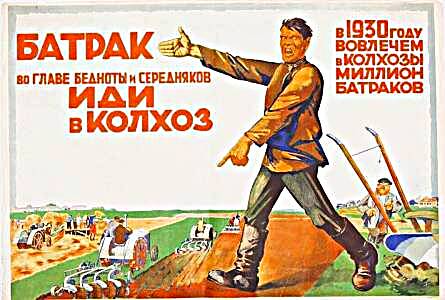
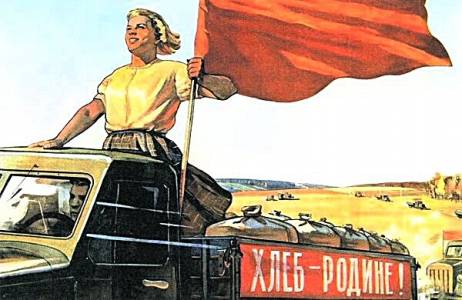
The two accompanying collectivization posters come from this Russian webpage entitled, "USSR collective farm posters for copying."
Collectivization: 12 myth-busters
(Dmitry Khmelnytskyi)
1. The terminology used by Soviet historiography to describe Stalin's reformation of the Soviet countryside in the late 1920s was obviously fake.
It masked the government's real intentions which had nothing to do with the official ideology or the official goals of "collectivization".
The Soviet government did not set up peasant "collectives"; rather it created serf farms owned by the state and worked by forced labor.
No ideological dogmas or social utopias lay behind Stalin's collectivization. It was a cold-blooded scheme of consolidation and maximum exploitation of the rural population.
Stalin's collective farms performd approximately the same tasks as labor brigades in the camps. And the civil rights of the "collectivized" peasants were roughly the same as those of convicts.
2. The beginning of "collectivization" marks the transformation of the Soviet Union into a completely illegal state.
During the New Economic Policy there were dictatorial, highly anti-democratic laws in the U.S.S.R.; but they were ineffective. Certain civil and property rights were enshrined by law. The mass repressions, deportations, expropriations and the liquidation of the remnants of public life since 1928 lacked a formal legal basis. From the point of view of Soviet legislation, forced collectivization was completely illegal.
3. There was no class war in the early days of "collectivization".
The hypothetical division of the peasantry into "kulaks", "middle peasants" and "poor peasants" was invented by Stalin to justify the repression against those peasants who defied "collectivization". The official promise of a prosperous life did not seduce the peasants. No one wanted to move to the collective farms, so the government arbitrarily designated well-to-do peasants and all those who resisted collectivization as "kulaks" or "sub-kulaks" subject to repression.
4. The Bolshevik dogma that collective farms were more productive than family farms was ideological hogwash. Stalin consciously lied from the very start of the collectivization process..
Various kinds of collective farms had already discredited themselves completely in the mid-1920s. Their productivity despite the state subsidies was much lower than the productivity of the family farms. All economists who drew up the Five-Year Plans knew this very well. By "collectivizing" the countryside the government did not intend to increase agricultural production, a goal achievable only through privatization. The goal was all about concentrating food production so that it could subsequently be appropriated by the authorities with a minimum effort and almost free of charge. Similarly the "nationalization" of the land made the government's chores easier but it degradated agriculture as a whole and sharply reduced [the potential] agricultural output.
[...]
11. The lower mortality rate from hunger in 1934 is explained not by the fact that the collective farms allegedly "finally got back on their feet and demonstrated their true potential" but by a huge drop in the sale of grain abroad.
This in turn is explained by the prescribed decrease in the international purchase of manufactured goods foreseen in the second Five-Year Plan. The bulk of the machinery and equipment earmarked for the newly-built industrial plants had already been bought during the first Five-Year Plan. As a result a greater proportion of the harvest stayed inside the country and was used to feed the population.
[...]
3Consequently socialist "wages" must be pegged according to the work performed and not to a worker's needs - 🗽 which is precisely how capitalism works. But why place the word wages inside quotation marks? Were Soviet workers occasionally "paid" in kind (food, cigarettes, boots, etc.)?
4whoever sets wage scales on the "principle" of equality ... breaks with Marxism, breaks with Leninism - 😕 Wage/income inequality fosters class division: "rich" workers/peasants, "middle" workers/peasants and "poor" workers/peasants.
5Let's pass to the third novelty - The third novelty was "the organization of work" and the task was "to put an end to lack of personal responsibility, to improve the organization of work and to secure the proper distribution of forces in our enterprises."
The fourth novelty was "a working-class industrial and technical intelligentsia" and the task was "to see to it that the working class of the U.S.S.R. has its own industrial and technical intelligentsia."
The fifth novelty was "signs of a change of attitude among the old industrial and technical intelligentsia" and the task was "to change our attitude towards the engineers and technicians of the old school, to show them greater attention and solicitude, to enlist their cooperation more boldly."
The sixth novelty was "business accounting" and the task was "to introduce and reinforce business accounting, to increase accumulation within industry."
6Let's pass to the third novelty - The following extract comes from the LiveJournal webpage entitled, "The myth of Stalin's 'industrialization'" written by maxim_nm.
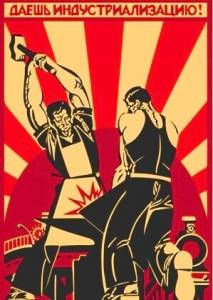
The first accompanying poster (below, left) comes from this Russian webpage. The poster is entitled, "Give us industrialization!"
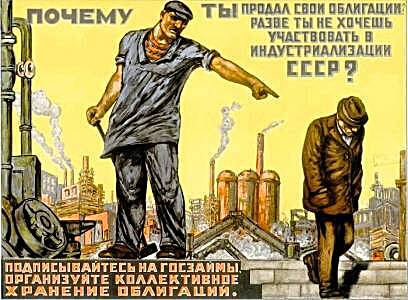
The second poster comes from this Russian webpage. The poster is entitled, "Why Did You Sell Your Bonds?"
The myth of Stalin's "industrialization"
(maxim_nm)
So, friends, today I have an interesting post on a long-planned topic, the so-called Stalinist "industrialization" which Soviet-era fans love to talk about and are incredibly proud of, repeating the silly phrase, "Stalin took over Russia with a wooden plow and left it with an atomic bomb." The phrase is silly if only because Stalin left Russia with a wooden plow: the peasants of Stalin's collective farms were forbidden to own their own draft animals and hence had literally to harness themselves to the plow to till the small parcel of land allotted for their family's sustenance.
Meanwhile the mendacious communist statistics constantly lied about how only under Stalin did industry start flourishing. This was a complete and utter lie. Russia had already achieved a very high degree of industrial progress at the turn of the 20th century and was gaining momentum when the October Revolution arrived and with it the years of stagnation (later called "devastation") brought on by the Civil War. So, in fact, the Soviet Union didn't "start" anything anywhere. On the contrary it aborted the normal growth of industry and set the country back several decades.
[...]
If you pay attention to the details of Soviet life in the 1930s, you'll see that it differed little from the reality of 1910, say. Nothing new appeared in the marketplace, furniture and other items were made by small artisans and no industrial capacity was devoted to improving everyday life or to manufacturing modern household appliances—whereas in the U.S.A., for example, washing machines and television sets were already in people's homes by the 1920s and 1930s.
Soviet "industrialization" focussed primarily on everything related to warfare: the arms industry, chemical and processing industries, steel mills, and the like.
It is also necessary to discuss how exactly the industrialization materialized. The funds ["accumulations"] were obtained by selling to Western countries the valuables that had been snatched from the "bourgeoisie" or by selling abroad the grain appropriated from the peasants at the cost of the Holodomor and millions of victims.
Meanwhile the workers who built the military-industrial complex wereprimarily Gulag inmates. The map of camp locations matches the site of Stalin's "new construction projects" exactly.
In pursuit of "industrialization" the Bolsheviks exterminated millions of people or emaciated them in concentration camps or despoiled villages guarded by troops. In this way the Bolsheviks deprived themselves of a normal future, destroyed the gene pool and replaced it with a few factories that became obsolete within a couple of decades.
5. TALK WITH THE GERMAN AUTHOR EMIL LUDWIG.
(December 13, 1931. Bolshevik, 8, April 30, 1932)
December 13, 1931
Ludwig: I am extremely obliged to you for having found time to receive me. For over twenty years I have been studying the lives and deeds of outstanding historical figures. I believe I'm a good judge of people, but on the other hand I know nothing about social-economic conditions.
Stalin: You are being modest.
Ludwig: No, that is really so, and for that very reason I shall put questions that may seem strange to you. Today, here at the Kremlin, I saw some relics of Peter the Great and the first question I should like to ask you is this: Do you think a parallel can be drawn between yourself and Peter the Great? Do you consider yourself a disciple of Peter the Great?
Stalin: In no way whatever. Historical parallels are always risky. There is no sense in this one.
Ludwig: But Peter the Great did a great deal to develop his country, after all, to bring western culture to Russia.
Stalin: Yes of course. Peter the Great did much to elevate the landlord class and nurture the nascent merchant class. He did very much indeed to create and consolidate the national state of landlords and merchants. It must also be said that the promotion of the landlord class, his assistance to the nascent merchant class and the consolidation of the national state of these two classes was done at the expense of the peasant serfs, who were bled white.
As for myself, I am just a pupil of Lenin's, and the aim of my life is to be a worthy pupil of his.
The task I have devoted my life to is the promotion of a different class, the working class. That task is not the consolidation of some "national" state but the consolidation of a socialist state, which implies an international state, Everything that strengthens that socialist state helps to strengthen the entire international working class. If every step I take in my endeavour to elevate the working class and to strengthen its socialist state were not directed toward bolstering and raising the status of the working class, I should consider my life meaningless.
So you see your parallel does not fit.
Comparing Lenin and Peter the Great, the latter was but a drop in the sea, Lenin was a whole ocean.
Ludwig: Marxism denies the outstanding role of individuals in history. Do you not see a contradiction between the materialist concept of history and the fact that, after all, you admit the outstanding role played by historical figures?
Stalin: No, there is no contradiction here. Marxism does not at all deny the role played by outstanding individuals or that history is made by people. In Marx's
The Poverty of Philosophy and in other works of his you will find it stated that it's people who make history. But, of course, people do not make history according to the promptings of their imagination or as some fancy strikes them.
Every new generation encounters a certain historical environment. And great individuals are worth something only to the extent that they are able to understand how to modify it. If they fail to understand society and wish to change it after the promptings of their imagination, they will land themselves in the world of Don Quixote.
Thus it's precisely Marx's view that individuals must not be counterposed to their historical environment. People make history but only to the extent that they understand their society correctly and how to change it. This is at least how we Russian Bolsheviks understand Marx. And we have been studying Marx for a good many years.
6. MAGNITOGORSK IRON AND STEEL WORKS PROJECT, MAGNITOGORSK.
(Pravda, 89. March 30, 1932)
Telegraphic news have arrived of the completion of the inauguration period and full operation of the first giant blast furnace in the U.S.S.R.
This blast furnace outputs over a thousand tons of liquid iron daily, equivalent to a daily output of about twelve hundred tons of hot metal for conversion to steel.
I congratulate the workers and the administrative and technical personnel of the Magnitogorsk Iron and Steel Works on their successful fulfilment of the first part of the Works' programme.
I congratulate them on mastering the technology of this unique gigantic blast furnace, the first of its kind in Europe.
Greetings to the male and female shock brigaders of the Magnitogorsk Iron and Steel Works who in the adverse conditions of winter overcame the difficulties of inaugurating and putting the blast furnace into full operation and who are readily bearing the brunt of the effort required to build the plant!
I have no doubt that the Magnitogorsk workers will likewise fulfil the main portion of the 1932 work programme successfully.
They will build three more blast furnaces, open-hearth furnaces and rolling machinery and will thus fulfil their duty to their country with honour.1,2
J. Stalin
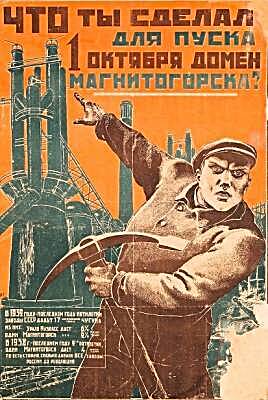
1 The accompanying photograph of the Soviet poster entitled, "What did you do to launch the Magnitogorsk blast furnace on October 1st?" comes from this Russian webpage entitled, "Personal file: Historian Ekaterina Kushnirenko on a propaganda poster from the Magnitostroy blast furnace construction era."
2 The following information on the Magnitogorsk Iron and Steel Works comes from Rodina's online publication internet portal, specifically from its article entitled, "Stalin to Kabakov: 'We can't blame everything on the frosts!'" Said article was uploaded on January 31, 2022, and is co-authored by Nikita Pivovarov and Olga Chagadaeva.
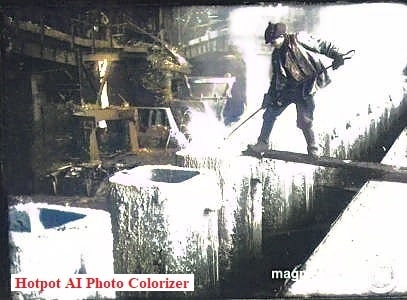
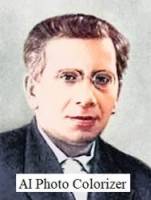
The accompanying photographs of a metallurgical worker (below, right) and of Amayak Makarovich Nazaretyan (below, left) were colorized with Hotpot.
Stalin to Kabakov: "We can't blame everything on the frosts!"
(Nikita Pivovarov and Olga Chagadaeva)
On January 31, 1932, the first blast furnace of the Magnitogorsk Iron and Steel Works, at the foot of Mount Magnitnaya, was commissioned and it became a symbol of the Era of Industrialization. "Stalin's Magnitka" was built on an incredible timeframe: the first construction workers arrived on the empty plateau in March 1929 and the first blast furnace was scheduled to start operating on October 1, 1930.
Within three years not only the world's largest metallurgical enterprise had emerged, but also Magnitogorsk the "firstborn of Stalin's Five-Year Plans": a city with a population of 200,000 inhabitants, underdeveloped and consisting mainly of barracks.
The construction of this industrial giant involved the American construction company Mackey plus 158 factories scattered across the country plus hundreds of foreign engineers, Soviet workers, volunteers, special settlers and labour camp inmates.
The volunteers didn't stay long at Magnitostroy because due to the Soviet leadership's passionate desire to save time and resources, the working and living conditions at the largest construction site in history were appalling.
It's no surprise that Magnitogorsk became one of the first cities to introduce a passport system (March-May 1933), The mobilization economy saw no other way of curtailing staff turnover. Workplace accidents and missed deadlines were taken as evidence of sabotage by the class enemy, and as a result, the enterprise faltered for several years following the triumphant inauguration of Blast Furnace No. 1.
Recently declassified Politburo documents shed light on the hardships of working in the "steel heart of the Motherland."
Exhibit No. 1. Letter from A.M. Nazaretyan to S. Ordzhonikidze
October 15, 1930 Sverdlovsk
Dear Sergo!
I visited Magnitogorsk. The construction of the dam (a kilometer long) is incredibly impressive. Work is going around the clock (I was there at 1:00 AM) and the project is ahead of schedule. Previously they were behind. After the district committee, the Committee of the Red Cross and the Workers' and Peasants' Inspectorate created fifty-four shock brigades things turned around and now work at the dam is going smoothly. Construction of the blast furnace has only recovered in the last few days after being significantly behind schedule.
Everything else is unspeakably bad.
Construction manager Schmidt is complacent. He's a complete idiot. The construction management doesn't listen to him, does whatever it wants and not a single one of his orders is implemented. The superbly equipped brick factory (six units) that produces remarkably high-quality bricks fired in Hoffmann kilns is actually performing at a terrible rate. Only two units are operational, less than 20% of the production plan is being fulfilled and there's no attention paid to the matter despite numerous orders from every side.
There are over twenty thousand registered construction workers but only 10-12 thousand in fact do work; the rest loiter in barracks and canteens. There is no supervision of the canteens. Workers wander from one to another, eating five or more meals a day. [...] In short, I think it's essential to put a real owner there as soon as possible. The current one is not a construction worker, let alone a giant. [...]
The Magnitogorsk staff is highly suspect. A whole rabble assembly, a ton of people with shady criminal records. They need to be cleaned out. We'll ask you for authorization to do so. [...]
It must be said that the fate of the Magnitogorsk construction project is analogous to the fate of the entire Urals industry. The continued absence of a production management center in the Urals has given rise to complete anarchy. Despite the heroic efforts of private shock workers, hundreds of brigades and Party organizations the breach remains unplugged. [...] In my opinion all this is because some fellows supply, others supervise and yet others manage—the devil himself can't figure out who's responsible for what. [...]
Your Amayak
† Amayak Makarovich Nazaretyan (1889-1937) was at this time a member of the Presidium of the Central Control Commission of the All-Union Communist Party (Bolsheviks). He was arrested in 1937 and shot on October 30. Source: Russian Wikipedia.
Exhibit No. 3. Note from the All-Union Central Council of Trade Unions
November 26, 1931
On the state of housing, public utilities, and cultural amenities in Magnitogorsk
To the Central Committee of the All-Union Communist Party (Bolsheviks) and the Council of People's Commissars of the USSR Comrades Stalin, Molotov, Kaganovich
[...] The All-Union Central Council of Trade Unions considers it necessary to inform the Central Committee of the All-Union Communist Party (Bolsheviks) and the Council of People's Commissars of the persisting extremely poor state of housing, public services and cultural amenities in Magnitogorsk. This is a direct threat to the progress and launch of construction [...]
By urging a completion of the industrial construction at all costs, economic bodies almost completely disregard the interests of the workers, the creation of normal living conditions for workers, engineers and technicians who will work in this enterprise (not to mention the construction workers) [...] By the time Magnitka is inaugurated, neither housing nor hospitals nor schools nor clubs nor theaters, etc., will be ready.
By October 1, 1931, twenty-five four-story masonry buildings and a hundred and fifty wooden-panel houses were to be built. All deadlines have long since passed and at present only five masonry buildings have been commissioned and the same number of unfinished buildings has been occupied
The following facts are illustrative: the availability of housing climbed by only 50% in 7-8 months whereas the number of workers rose by 140% during the same period. Hospital construction is also very unsatisfactory. As of October 1, only thirteen out of twenty-two projects were running, their completion rate is 70-75%.
All the workers were moved from tents to barracks by the October anniversary. Currently about four thousand collective-farm workers dwell in tents (albeit insulated). The kulaks dwell in barracks.
The current standard living space is just 1.7 square meters. Single workers and their families dwell in barracks in crammed, very unsanitary conditions: filth, insufficient air and light, no windows, a huge infestation of bedbugs, lice, and fleas, bedding not washed for months. [...]
[...]
The rise in illness and mortality is very alarming.[...] Over the past three months five hundred and four children under three years of age have died, and so have a hundred and seventy-four children three-to-six years old.
The existing hospital is designed for four hundred and thirty-five beds, but over a thousand are actually deployed. Every corridor is filled with hospital beds. There are only three ambulances in a seventy-kilometer radius for a population of a hundred and ninety thousand, yet the number of workplace accidents is climbing.
[...]
Secretary of the All-Union Central Council of Trade Unions G. Weinberg
† Gavriil Davydovich Weinberg (1891-1946) died a natural death.
Exhibit No. 4. Coded telegram from I.V. Stalin to I.V. Kabakov
January 27, 1933
Top Secret Copy Cipher To Sverdlovsk Regional Committee and Comrade Kabakov
What's happening at the Magnitogorsk blast furnaces? Why has iron production stopped? We can't blame everything on the cold weather, as the people of the Urals understand that the Urals winter, renowned for temperatures of -40 degrees Celsius and below, cannot serve as grounds for canceling production at the blast furnaces in Magnitogorsk. Why are senior Magnitogorsk officials sitting in Sverdlovsk at the Regional Committee plenary session? What are they doing there? Can't they be sent at once to Magnitogorsk to work? You and the Regional Committee Bureau will be held accountable to the Central Committee for any irregularities at Magnitogorsk. Keep it in mind.
I. Stalin.
† Ivan Dmitrievich Kabakov (1891-1937) was at this time the First Secretary of the Ural Regional Committee of the All-Union Communist Party (Bolsheviks). He was arrested in 1937 and shot on October 30. Source: Russian Wikipedia.
Exhibit No. 5. N.G. Myshkov to S. Ordzhonikidze the People's Commissar of Heavy Industry of the USSR
February 1, 1933
Myshkov reports the following on the telephone about the state of the blast furnace shop:
1. The blast furnaces are in a state of disrepair. The first blast furnace is running without producing pig iron; it will take several days to restore normal operation. The second blast furnace has cooled sufficiently to be restarted with the help of the first. It is difficult to estimate the exact start-up date for the second blast furnace. The tracks and the shop itself are littered with spilled pig iron and trestles. A significant number of workers has been transferred to the blast furnace shop to clean up the entire area. The locomotive fleet is in poor condition. With Kabakov's help, twenty-five highly qualified mechanics were hired to repair the locomotives, but they have not yet arrived.
2. Regarding the third blast furnace, the Kling valves and the gate valves have arrived, the casting machine not yet. He asks that pressure be brought to bear on the Debaltseve and Taganrog plants to expedite the manufacture of the casting machine.
3. There is a significant number of criminals on site. Mass robberies occur. The police are unable to cope with these elements. They are requesting the immediate eviction of 20-30 thousand people not related to the construction project. [...]
† Nikolai Gordeevich Myshkov (1894-1937) was at this time Head of Construction and Director of the Magnitogorsk Iron and Steel Works. He was arrested in 1937 and shot on November 26. Source: Russian Wikipedia.
8. TO THE BUILDERS OF THE DNIEPER HYDRO-ELECTRIC POWER STATION.
(Pravda, 281. October 10, 1932)
Unfortunately I shall be unable to comply with your request to attend the inauguration of the Dnieper Power Station as my work makes it impossible for me to leave Moscow.
Hearty greetings and congratulations to the workers and executive personnel of the Dnieper Power Station on the successful completion of this great historic work of construction.
I firmly shake the hands of the Dnieper Power Station shock brigaders, the glorious heroes of socialist construction.1
J. Stalin
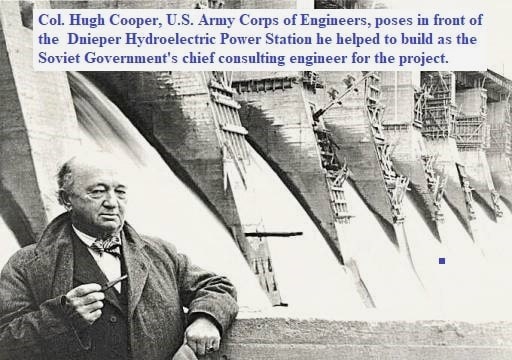
1 The accompanying photograph of Col. Hugh Cooper (above, left) comes from this Russian webpage entitled, "On October 10, 1932, the grand opening of the DneproGES took place!"
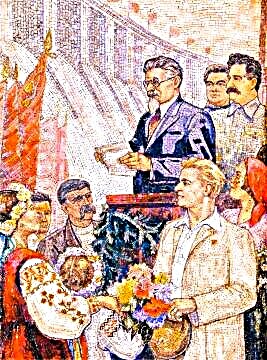
The photograph of the propaganda mosaic (above, right) comes from LiveJournal's webpage entitled, "DneproGES: From Propaganda to Reality" (read).
Youtube: Launch of the Dnieper Hydroelectric Station (1932).
9. THE FIFTEENTH ANNIVERSARY OF THE OGPU.
(Pravda, 350. December 20, 1932)
Greetings to the officials and troops of the OGPU, who are honestly and courageously fulfilling their duty to the working class and to the peasantry of the Soviet Union!
I wish them success in the difficult task of eradicating the enemies of the dictatorship of the proletariat! 1
Long live the OGPU, the bared sword of the working class!
J. Stalin
1I wish them success in the difficult task of eradicating the enemies of the dictatorship of the proletariat! - The fifth joke is the pertinent one here.
10. JOINT PLENUM OF THE CENTRAL COMMITTEE AND CENTRAL CONTROL COMMISSION.
(January 7, 1933)
THE RESULTS OF THE FIRST FIVE-YEAR PLAN
Report Delivered on January 7, 1933
[...]
VII
THE RESULTS OF THE FIVE-YEAR PLAN IN FOUR YEARS IN THE SPHERE OF THE STRUGGLE AGAINST THE REMNANTS OF THE HOSTILE CLASSES
As a result of the fulfilment of the Five-Year Plan in industry, agriculture and trade we have established the principle of socialism in all spheres of the national economy and have expelled the capitalist elements from them.
What should this have led to in relation to the capitalist elements; and what has it actually led to?
It has led to this: the last remnants of the moribund classes—private manufacturers and their servitors, private traders and their henchmen, former nobles and priests, the kulaks and their agents, former Whiteguard officers and police officials, policemen and gendarmes, all sorts of chauvinist bourgeois intellectuals and all other anti-Soviet elements—have been knocked out of their groove.
Knocked out of their groove and scattered over the whole face of the U.S.S.R., these "have-beens" have wormed their way into our plants and factories, into our government offices and trade establishments, into our railway and water transport enterprises and, principally, into the collective farms and state farms. They have crept into these places and taken cover there, donning the mask of "workers" and "peasants"; some have even managed to worm their way into the Party.
What did they carry with them into these places? Of course they carried hatred toward the Soviet regime, burning enmity toward the new economy, life and culture.
These gentlemen can no longer launch a frontal attack on the Soviet regime. They and their classes made such attacks several times but they were routed and dispersed. Hence the only thing left for them to do is mischief and harm to the workers, the collective farmers, the Soviet regime and the Party. And they are doing as much mischief on the sly as they can. They set fire to warehouses and wreck machinery.2
They practise sabotage. They go on wrecking sprees in collective or state farms. Some, certain professors included, even inject plague and anthrax in the cattle belonging to collective or state farms, spread meningitis among horses, etc.
But that's not the main thing. The chief "work" of these "have-beens" is mass theft and plunder of state, co-operative and collective-farm property. Theft and plunder in factories and plants, theft and plunder of railway freight, theft and plunder in warehouses and trading houses—particularly theft and plunder in state or collective farms.3
Such is the chief "work" of these "have-beens." Their class instinct informs them, as it were, that the foundation of the Soviet economy is public property, therefore it must be eroded to weaken the Soviet regime, and they try indeed to erode it through mass theft and plunder.
[...]
VIII
GENERAL CONCLUSIONS
[...]
General conclusions:
1. The results of the Five-Year Plan have refuted the bourgeois and Social-Democratic leaders who asserted that the Five-Year Plan was a fantasy, delirium, an unrealizable dream. The results show that the Five-Year Plan has already been fulfilled.
2. The results of the Five-Year Plan have shattered the well-known bourgeois "article of faith" that the working class can not build anything new, that it can only destroy what is old.4
The results have shown that the working class is just as able to build the new as to destroy the old.
3. The results of the Five-Year Plan have shattered the Social-Democrat thesis that it's impossible to build socialism in one country alone. The U.S.S.R. has already set the example of how to build a socialist society in one country alone.
4. The results of the Five-Year Plan have refuted the bourgeois economists who asserted that capitalism is the best system, that every other system is unstable and unable to withstand the challenges of economic growth.
The results have shown that capitalism is bankrupt, unstable, that it has outlived its day and must give way to the superior Soviet socialist economy. The Soviet system alone does not fear crises and can beat the challenges that capitalism cannot.
5. Finally the results of the Five-Year Plan have shown that the Communist Party is invincible if it sets itself a goal and if it does not fear difficulties.
(Stormy and prolonged applause, increasing to an ovation. All rise to greet Comrade Stalin)
1 The Joint Plenum of the Central Committee and Central Control Commission took place on January 7-12, 1933. The plenum discussed the First Five-Year Plan and the economic outlook for 1933, first year of the Second Five-Year Plan. Comrades Stalin, Molotov, and Kuibyshev reported on this question.
The plenum also tackled the goals and tasks of the political departments in machine-and-tractor stations or state farms and tackled intra-Party issues.
J. V. Stalin presented a report on "The Results of the First Five-Year Plan" on January 7.
J. V. Stalin delivered a speech on "Work in the Countryside" on January 11.
The plenum declared the fulfilment of the First Five-Year Plan in four years to be the most outstanding event of current history and that the "New Construction" slogan for the Second Five-Year Plan must be supplemented with the slogan of mastering the new industrial projects and boosting the new agricultural undertakings.
The plenum instructed all economic, Party and trade-union cells to prioritize raising labour productivity and lowering production costs (see Item 3, footnote 1).
The plenum decided to structure the political departments of machine-and-tractor stations and state farms so as to enhance their status and influence over the countryside and to improve the work of the Party in the collective farms and in the state farms.
The plenum approved the decision of the Politburo to conduct a Party purge during 1933 and to block admission to the Party until the end of said purge.
2They set fire to warehouses and wreck machinery - Stalin should have re-read "WHAT IS HAPPENING IN THE COUNTRYSIDE?" instead of blaming "the last remnants of the moribund classes" for the arson (Collected Works of V. I. Lenin & Galiciana, Chapter 13, Item 5).
3Theft and plunder in factories and plants, theft and plunder of railway freight, theft and plunder in warehouses and trading houses—particularly theft and plunder in state or collective farms - Stalin should have also remembered his musings on "carefree theft" at Soviet institutions (Chapter 8, Item 1, Section IV).
4The results of the Five-Year Plan have shattered the well-known bourgeois "article of faith" that the working class can not build anything new, it can only destroy what is old - Sophistry. Every new Soviet enterprise was built by the Soviet working class under the tutelage of foreign bourgeois companies and engineers (e.g., see Collected Works of V. I. Lenin & Galiciana, Chapter 28, Items 1 and 3; Chapter 29, Item 5; Chapter 30, Item 16, news of Tuesday May 15, 1923; Chapter 31, Items 21 and 35).
11. REPORT OF THE CENTRAL COMMITTEE TO THE SEVENTEENTH PARTY CONGRESS.1
(January 26, 1934. Pravda, 27, January 28, 1934)
January 26, 1934
[...]
II
THE CONTINUING PROGRESS OF THE NATIONAL ECONOMY AND THE INTERNAL SITUATION IN THE U.S.S.R.
[...]
2. THE PROGRESS OF AGRICULTURE
[...]
It is not surprising therefore that the colossal progress of the economy and culture of the U.S.S.R. during the period under review has at the same time meant the elimination of the capitalist elements and the relegation of family farming to the background. It is a fact that the socialist economy in the field of industry now constitutes 99% of the total. It constitutes 84.5% of the total in agriculture according to the area sown to grain crops; family farms contribute only 15.5%.
It follows then that the capitalist economy has been superseded in the U.S.S.R. and that family farming has been demoted to second place.
[...]
To begin with, these People's Commissariats [People's Commissariat of Agriculture and People's Commissariat of State Farms] are more infected than others with the disease of red tape. Decisions are made but no thought given to verifying their fulfilment or taking to task they who disobey the instructions and orders issued by the leading bodies or to promoting the honest and conscientious workers.
One would think that the huge number of tractors and machines would impose on the territorial organs the obligation to keep these valuable machines in good order, to see to their timely repair, to run them more or less efficiently.
What are they doing in this regard? Very little unfortunately. The maintenance of tractors and machines is unsatisfactory. Repairs are also unsatisfactory because even to this day there is a refusal to understand that minor and moderate repairs must not be put off. The flaws in how tractors and machines are used are too obvious and well known to merit comment.
An immediate farming task is to rotate crops properly, to increase the area of clean fallow and to seek the improvement of seeds in all branches of agriculture. What is being done in this respect? Unfortunately very little as yet. The keeping of grain and cotton seed is so muddled that it will take a long time to put straight.
An effective means of increasing the yield of industrial crops is to use fertilizers. What is being done in this respect? Very little as yet. Fertilizers are available, but the organs of the People's Commissariat of Agriculture do not acquire them, and when they do, they do not deliver them on time to where they are required nor do they verify a proper usage.
In regard to state farms it must be said that they still fail at their tasks. I do not in the least minimize the great radical role of our state farms. But if we compare what huge sums the State has invested to current state-farm yields we find an enormous debit on the state-farm ledger. The principal reason is that our state grain farms are too unwieldy; the directors cannot manage them. State farms are too niched, they do not rotate crops or leave fallow land, they do not raise livestock. Evidently the state farms will have to be split up and the excessive specialization ended. One might think the People's Commissariat of State Farms raised this issue opportunely and solved it, but that is not so. The issue was raised and settled by outsiders.
Finally there is the question of livestock farming. I reported already on the serious livestock situation. One might think that our territorial organs would display feverish activity to end the livestock crisis, sound the alarm, mobilize personnel and tackle the problem. Unfortunately nothing of the kind has happened or is happening. They not only failed to sound the alarm, their reports tried to gloss over the problem and sometimes even conceal it from public opinion, which is absolutely impermissible for Bolsheviks. To expect after this that the territorial organs can raise livestock farming to its proper level is to daydream. The whole Party and all our workers must lend a hand, bearing in mind that today's livestock problem is as important as the grain problem (now resolved) was yesterday. There is no need to argue that our Soviet people who overcame many serious obstacles in the path to success can clear this hurdle as well.
(Thunderous applause)
That's a brief and far-from-exhaustive enumeration of defects to eradicate and of tasks for the immediate future.
[...]
4. THE PROGRESS OF TRADE TURNOVER AND TRANSPORT
Thus we have:
a) An increase in the output of industry, including goods for mass consumption.
b) An increase in agricultural output.
c) Growth in the requirements and the demand for produce and manufactured goods on the part of the toiling masses of town and country.
What more is needed to co-ordinate these factors and ensure that all consumers receive the necessary goods and produce?
Some comrades think that the factors alone suffice for the economic life of the country to go full steam ahead. That's a profound delusion. We can imagine a situation where all these factors exist but if the goods do not reach the consumers the market will be dislocated and shaken to its foundations. It is high time to realize that in the final analysis goods are produced not for the sake of production but for the sake of consumption.2
There were cases where we had many goods and much produce which did not reach the consumers but plodded for years in the swamp of our so-called distribution network bureaucracy.
Naturally industry and agriculture lost all their incentive to raise output while the distribution network overstocked and workers and peasants went without. The economic life of the country was disrupted despite the existence of goods and produce.
If the economic life of the country is to steam full speed ahead with an incentive for industry and agriculture to raise production, one more factor is required, namely, a mature trade turnover between town and country everywhere. The country must be covered with a vast network of wholesale distribution points, shops and stores. There must be a ceaseless flow of goods through these places, shops and stores, from producer to consumer. The state trading system, the co-operative trading system, the local industries, the collective farms and the individual peasants must be drawn into this task.
This is what we call fully developed Soviet trade, trade without capitalists, trade without speculators.3
As you see, the expansion of Soviet trade is a very urgent problem which must be solved or further progress will be rendered impossible.
[...]
III
THE PARTY
[...]
2. QUESTIONS OF ORGANIZATIONAL LEADERSHIP
[...]
Besides the incorrigible bureaucrats and red-tape addicts, whose removal triggers no disputes among us, there are two other executive types who delay our work, hinder it and stall our progress.
One executive type rendered certain services in the past and is now a big-wig who considers that Party decisions and Soviet laws are not written for him but for fools. These executives do not deem it their duty to obey the decisions of the Party and of the Government. They thus erode the foundations of Party and state discipline. What do they count upon when they breach Party decisions and Soviet laws? They presume that the Soviet Government will not venture to touch them because of their past services. These overconceited big-wigs think that they are irreplaceable and thus can ignore the decisions of the leading bodies with impunity.
What is to be done with such executives?
They must be removed from their leading posts unhesitatingly, irrespective of their past services.
(Voices: "Quite right!")
They must be demoted to inferior ranks and this must be published in the press.
(Voices: "Quite right!")
It is essential to take those conceited big-wig bureaucrats down a peg or two and put them in their proper place. It is essential to strengthen Party and Soviet discipline in our whole work.
(Voices: "Quite right!" Applause)
And now about the second type of executive.
I have in mind the windbags, I would say honest windbags...
(Laughter)
... people who are honest and loyal to the Soviet power but are incapable of leadership, incapable of organizing anything.
Last year I had a conversation with one such comrade, a very respected comrade but an incorrigible windbag capable of drowning any functional undertaking in a flood of talk.
Here's the conversation:
I: How are you getting on with the sowing?
He: With the sowing, Comrade Stalin? We have mobilized ourselves.
(Laughter)
I: Well, and what then?
He: We have put the question squarely.
(Laughter)
I: And what next?
He: There is a turn, Comrade Stalin; soon there will be a turn.
(Laughter)
I: But still?
He: We can see an indication of some improvement.
(Laughter)
I: But still, how are you getting on with the sowing?
He: So far, Comrade Stalin, we have not made any headway with the sowing.
(General laughter)
There you have the portrait of the windbag. They have mobilized themselves, they have put the question squarely, they have a turn and some improvement, but things remain as they were.
This is exactly how a Ukrainian worker depicted a certain organization when asked whether it had a definite line recently:
"Well," he said, "as to a line ... they have a line alright but they don't seem to be doing any work."
(General laughter)
Evidently that organization too has its honest windbags.
And when such windbags are dismissed from their posts and given jobs far removed from operational work, they shrug their shoulders in perplexity and ask: "Why have we been dismissed? Did we not do what was necessary to get the work done? Did we not call a rally of shock brigaders? Did we not read out the slogans of the Party and of the Government there? Did we not elect the whole Politburo to the Honorary Presidium?"
(General laughter)
"Did we not send greetings to Comrade Stalin? What more do you want from us?"
(General laughter)
What is to be done with these incorrigible windbags? Why, if they were allowed to stay on operational work they are capable of drowning every live undertaking in a flood of watery and endless speeches.
Obviously they must be removed from leading posts and given work elsewhere.
There is no room for windbags in operational work.
(Voices: "Quite right!" Applause)
[...]
I am coming to the end of my report, comrades.
What conclusions must be drawn?
Everybody admits now that our successes are great and extraordinary. In a relatively short space of time our country has been shunted to the track of industrialization
and collectivization. The First Five-Year Plan has been carried out successfully. This evokes a feeling of pride among our workers and raises their self-confidence.
That's very good of course. But successes sometimes have their seamy side. They give rise sometimes to certain perils which, unchecked, may wreck the whole work. There is for example the danger that some comrades may become dizzy with success. There have been such cases among us, as you know. There is the danger that certain comrades intoxicated with success will get swelled heads and begin to lull themselves with boastful songs such as "It's a walkover" or "We can knock anyone into a cocked hat," etc. This is not obviated, comrades. There is nothing more dangerous than this sort of feelings for they disarm the Party and demobilize its ranks. If such feelings gain the upper hand in our Party we may be faced with the danger of watching all our successes ruined.
Of course the First Five-Year Plan has been carried out successfully. That's true. But the matter does not and cannot end there, comrades. Before us is the Second Five-Year Plan which we must also carry out successfully. You know that these Plans are only done by overcoming difficulties. That means there will be difficulties and there will be struggle.
Comrades Molotov and Kuibyshev will report on the Second Five-Year Plan. From their reports you will see what great difficulties lie ahead. This means that we must not lull the Party but heighten its vigilance. We must not lull it to sleep but keep it ready for action; not disarm it but arm it; not demobilize it but keep it mobilized to fulfil the Second Five-Year Plan.
Hence the first conclusion: We must not become infatuated with the success achieved and must not become conceited.
[...]
Hence the second conclusion: We must remain true to the end to the great banner of Marx, Engels, Lenin.
[...]
Hence the third conclusion: We must be true to the end to the cause of proletarian internationalism, to the cause of a fraternal alliance of all the world's proletarians.
(Applause)
Those are the conclusions.
Long live the great and invincible banner of Marx, Engels and Lenin! 4
(Stormy and prolonged applause from the whole hall. The congress gives Comrade Stalin an ovation. The "Internationale" is sung, after which the ovation resumes with renewed vigour. Shouts: "Hurrah for Stalin!" "Long live Stalin!" "Long live the Central Committee of the Party!")
1 The Seventeenth Party Congress was held in Moscow from January 26 to February 10, 1934. It discussed the report of the Central Committee, the reports of the Central Auditing Commission, Central Control Commission and Workers' and Peasants' Inspection, the Party delegation in the Executive Committee of the Comintern and reports on the Second Five-Year Plan and on Party and Soviet affairs.
The congress wholly approved the political line and practical work of the Central Committee and instructed all Party cells to be guided by the principles and tasks enunciated in J. V. Stalin's report.
The congress noted the decisive successes of socialist construction in the U.S.S.R. and declared that the general line of the Party had triumphed. The Seventeenth Party Congress has gone down in the history of the Party as the Congress of Victors.
The congress adopted a resolution on "The Second Five-Year Plan of Development of the National Economy of the U.S.S.R. (1933-1937)". This Plan envisaged finishing the technical reconstruction of the entire national economy and a still faster rise in the living and cultural standards of workers and peasants.
The congress stressed that the basic political task during the Second Five-Year Plan was the final elimination of capitalist elements in economic life and in the minds of people.
The congress adopted new Party Rules. It replaced the Central Control Commission and Workers' and Peasants' Inspection by a Party Control Commission under the Central Committee and a Soviet Control Commission under the Council of People's Commissars.
2It is high time to realize that in the last analysis goods are produced not for the sake of production but for the sake of consumption - Modern example: China's EV Car Bubble is Finally Bursting! (serpentza, dated December 31, 2025).
3This is what we call fully developed Soviet trade, trade without capitalists, trade without speculators - The first joke is the pertinent one here.
4 The accompanying photographs of the presidium of the Seventeenth Party Congress (above, right) and of J. V. Stalin delivering the political report of the Central Committee on January 26 (above, left) come from this Russian webpage entitled, "'To knock down the arrogance and put them in their place.' 90 years ago, Stalin decided to deal with his enemies. Thus began the Great Terror." Both photos were colorized with Lunapic.
12. INSTEAD OF A REPLY TO THE DISCUSSION.
(January 31, 1934. Pravda, 31, February 1, 1934)
January 31, 1934
The discussion at this congress has revealed a complete unity of views by our Party leaders on, one can say, all questions of policy.1 As you know, no objections whatever to the report were raised. Hence there is extraordinary ideological, political and organizational solidarity in our ranks.
(Applause)
The question arises: Is there any need after this for a reply to the discussion?
I do not think there is. Permit me therefore to refrain from making any concluding remarks.
(A stormy ovation. All delegates rise to their feet. Thunderous shouts: "Hurrah!" A chorus of shouts: "Long live Stalin!" The delegates sing the "Internationale." Ovation resumes. Shouts: "Hurrah!" "Long live Stalin!" "Long live the Central Committee!")
1The discussion at this congress has revealed a complete unity of views by our Party leaders on, one can say, all questions of policy - 💀 More than twenty years earlier Stalin had said (Chapter 2, Item 5):
In pursuing these aims we do not in the least intend to gloss over the disagreements that exist among Social-Democratic workers. More than that: in our opinion a powerful and virile movement is inconceivable without disagreements, for "complete identity of views" can exist only in the graveyard!
("Our Aims" in Pravda, 1, Old Style April 22, 1912)
13. KERENSKY'S TWO LECTURES IN MADRID.
(News from Galiciana)
Five pertinent Russian videos may be watched by clicking on their hyperlink. Three original videos were clipped and spliced (left column below).
The splicing was done with BeeCut. The three spliced videos were subsequently reduced in size to enable uploading to the free NEOCITIES host. Compression was performed with FreeConvert.
Thursday April 3, 1930. El Correo Gallego, decano de la prensa provincial (Ferrol), page 1.
Moscow: The authorities of Rogachev (Volgograd Oblast) have proscribed the slaughter of animals according to the Jewish rite. The measure made a deep impression on religious Israelite circles. The Tcheka arrested all the Jewish butchers of the city, accusing them of anti-Soviet propaganda.
Thursday August 14, 1930. El Correo Gallego, decano de la prensa provincial (Ferrol), page 1.
Moscow: Police have uncovered a plot directed and nurtured by several Right Communist officers of the 18th Infantry Regiment. These officers were arrested along with a sizeable number of civilians.
Thursday November 27, 1930. El Correo Gallego, decano de la prensa provincial (Ferrol), page 2.
London:The Evening News published a report tonight stating that some Russian officials recently arrived to Berlin explained the present isolation of Russia.
These officials said that five days ago a conspiracy by Red Army officers was uncovered. The officers counted on support from Rykov the president of the Council of People's Commissars. The majority of the seven hundred officers arrested, mainly in Moscow, has been shot already. Exposure of the plot caused a "formidable" impression on Stalin who secluded himself in the Kremlin and ordered that all houses round about be immediately vacated and billeted by troops. In Moscow alone seven thousand soldiers were detained.
The Russian commercial delegation in London tonight noted that it had not received any such news from Russia.
Saturday November 29, 1930. El Correo Gallego, decano de la prensa provincial (Ferrol), page 4.
London: The Daily Express correspondent in Russia has furnished interesting details about the events of last Thursday [November 27] at the Soviets Office in the Kremlin.
The destitution of Rykov and his supporters was on the agenda. Voroshilov the War Commissar opposed it vehemently saying that he had soothed the discontent brewing in the Red Army and growing daily. "The Army has not received even a quarter of its wheat ration since October," he said, "and for two years there has been no footwear available for soldiers or draftees." Enraged by Voroshilov's attitude, Stalin threatened him with summary execution whereupon Voroshilov threatened Stalin with a bombing of the Kremlin by the Air Force and a Navy bombardment of all pro-Stalin harbours. The two then came to blows.
The meeting started at 11:00 A.M. and lasted until 4:00 A.M. Afterward the Red Guard and the G.P.U. were beefed up.
Thursday April 27, 1933. El Correo Gallego, decano de la prensa provincial (Ferrol), page 1.
Kerensky's first lecture in Madrid
Madrid, 26: Sixteen years ago he was thirty-five years old and head of the Provisional Government. Yesterday night at La Zarzuela Theater Kerensky delivered in French the first of three conferences on the Bolshevik dictatorship. Yesterday's examined the causes of the Czar's fall and Lenin's takeover.
Czar Nicholas II had not secured the national unity required to embark upon World War I with any probability of success. Instead the Emperor, egged on by his wife and by Rasputin, unleashed a violent struggle against all the liberal elements while the country oozed blood and economic fatigue set in.
The Army was already in full rot two months before the fall of the monarchy. In January 1917 the tally of deserters was a million.
The Left did not do the February Revolution. It was done by patriots fairly close to the Throne who understood that they had to choose between loyalty to the Emperor and loyalty to the Fatherland.
Verifiably Protopopov (the last figure of the Czarist regime, friend and patron of Rasputin) attempted to reach a separate peace with the Central Empires (Germany and Austria-Hungary). He together with the Bolsheviks coordinated mutinies and strikes at ordnance factories.
The Provisional Government found itself on very difficult terrain in all fields. Being democratic it had to tolerate Bolshevik propaganda.
The Bolsheviks did not present themselves in public as the promoters of a dictatorship but as politically more liberal and democratic than the Kerensky Cabinet. Had they disclosed their real goals honestly they would have never triumphed because the Russian population loves freedom. The outcome of the Constituent Assembly elections proves it: Lenin's host got only 160 out of 601 seats. Those elections were the only free ones held under the Bolshevik regime.
As is well known, the Assembly was dissolved at the point of bayonets. Nevertheless the Russian people resisted Communist tyranny over the years despite Moscow's recourse to terror.
In contrast the German socialists and democrats succumbed to Hitler's dictatorship without putting up the least bit of resistance.
Friday April 28, 1933. El Correo Gallego, decano de la prensa provincial (Ferrol), page 1.
Letter of Tolstoy's daughter
Alexandra Tolstaya is the daughter of Leo Tolstoy the great novelist who brewed a restive temper in the Russian people with his absurd social theories.
Alexandra Tolstaya publishes the following open letter under the title, "I can not keep silent."
When the Czarist Government sentenced a few revolutionaries to death a shout blared from my father's mouth, "I can not keep silent!" And the Russian people unanimously seconded the shout of protest against that murder.
Now as thousands of human beings in the North Caucasus are being shot or exiled and my father no longer lives I feel a pressing need to raise my weak voice against Bolshevik atrocities, more so since I worked with the Soviet Government for twelve years and I saw with my own eyes how the terror spread.
The world kept silent. Millions of men were exiled or perished in prisons and concentration camps. Thousands were shot on the spot.
The Bolsheviks first attacked the class enemy: believers, clerics, teachers, the men of wisdom. Now they set upon workers and peasants ... and the world remains silent.
The Russian people endure slavery, famine and cold since fifteen years ago. The Bolshevik Government keeps oppressing them, seizes their wheat and other goods for export abroad because it needs cash not only for machinery but also to spread Communist propaganda the whole world over. And if peasants protest or hide their wheat to feed their hungry families ... they are shot.
The Russian people no longer have the strength to endure their suffering. Revolt throbs everywhere: factories, workshops, towns and across entire regions even. The penniless starving farmers flee Ukraine in their thousands.
And meantime what does the Soviet Government do? It publishes decree after decree to expel thousands of citizens from Moscow and other large cities. It suppresses rebellious peasants with internal exile and firing squads.
Russia has not witnessed worse atrocities since Ivan "The Terrible." And now when masses of Kuban Cossacks rebelled, entire families were shot by order of Stalin and 45,000 persons were exiled to Siberia to perish there, forsaken.
Is it possible for the Universe to keep silent? Can some Governments still maintain relations with those assassins and send them aid in detriment of their own countries?
Is it possible for an idealist writer like Romain Rolland (who understood the soul of great pacifists like Tolstoy and Ghandi) and writers like Henri Barbusse and Bernard Shaw to go on singing the praises of the Communist paradise?
Hence these become responsible for spreading Bolshevik principles which threaten the whole world and will lead it to ruin.
Is it possible for someone to still believe that the bloodthirsty Dictatorship of a few destroyers of culture, religion and morality can be dubbed socialism?
Will someone shout with me, "I can not keep quiet!" so that everyone hears us?
Where are you, Christians, genuine pacifists, writers and workers? Why your silence? Do you still need proofs, testimonies, statistics? Do you not hear the voices pleading for help? Or do you fancy that mankind's happiness can be procured through brute force, massacres and the enslavement of an entire population?
I am not addressing those whose Communist sympathies were purchased with the money snatched from the Russian people. I am addressing those who still believe in the fraternity and equality of men: Christians, socialists, writers, political or social workers, women, mothers.
Open your eyes! Join in unanimous protest against the executioners of a defenceless people!
Wednesday May 3, 1933. El Correo Gallego, decano de la prensa provincial (Ferrol), page 4.
Kerensky's second lecture in Madrid
Madrid, 2: The numerous public assembled in La Zarzuela Theater listened to Kerensky's second conference with genuine angst. Kerensky with a sincere eloquence dictated by patriotism and sorrow for his suffering people has proven with data that leaves no room for doubt that the famed Five-Year Plan trumpeted by Moscow has floundered in a most tragic fashion.
Stalin's Plan is not the first of its kind in the sphere of managing the economy for political ends. The first experience was authored by Lenin himself between 1918 and 1921. It was abandoned when famine and cannibalism broke out in regions that had previously been Europe's granary. Lenin then introduced the N.E.P., i.e., the "New Economic Policy," which parted with the absurd system of pure communism and granted some degree of freedom to peasants and businessmen. But the N.E.P. dispensed too much prosperity to the peasant who, as the year 1927 approached, felt strong enough to validate his political influence.
Stalin and Trotsky (when they still cooperated) understood that holding on to power required rending the weal of the peasants in a most radical fashion. That's the goal of the Five-Year Plan. More accurately the plan modified by Stalin, for the primitive project contained some praiseworthy items. The primitive plan, prior to Stalin's meddling, envisaged subsidizing the individual peasant and only in its fifth year would a quarter of peasant holdings be collectivized. On the other hand the plan executed by Stalin is a plan to smash the peasant class using terror, deportations, mass shootings and other methods we can hardly imagine. Every dictator, harsh as he may be, is a kid compared to Stalin.
It can be said that Russia's agriculture is undone.
Trotsky used to say that a satisfied peasant posed the greatest peril to the Bolshevik regime, and earlier Lenin used to say that "our socialism is a socialism of misery." Stalin the disciple of the two autocrats sets out to exterminate the peasants as a class. He says of course that his harsh measures affect the kulaks only, i.e., the rich pesants, but Stalin esteems that a peasant who owns two horses or two cows or more than ten hectares of land is already a "kulak" destined to perish in the forced labour camps of Murmansk and Northern Siberia. In reality the kulaks were only between 2-3% of the population, they did not represent a genuine social danger at all. The reality is that Stalin wages war against all the peasants, and their fate elicits the deepest pity.
Russia is again threatened by a famine that is causing havoc but which next autumn will assume proportions unseen in European history.
"When I am accused of fighting the Communists because they deposed me from Power," said Kerensky, "I reply that Power matters nothing to me, what matters to me only is the welfare of my people."
(Stormy and prolonged applause)
What little Stalin and his collaborators have garnered from his Plan is owed to projects they found drawn up in the ministries. For example the "Dniepostroi," i.e., the gigantic hydroelectric power plant on the Dnieper. Or the Turk-Sib Railway (Turkistan-Siberia). The work had already started on the railway before the Bolshevik Revolution halted it. The Dniepostroi with its price tag of a thousand million gold rubles is practically useless, and the same can be said about the Turk-Sib Railway for there is no cotton in Turkestan and there is no wheat in Siberia, so the railway hauls nothing. And these projects could not have been carried out without the foreign capitalists who, in their pursuit of profit, lent money to the Bolsheviks.
Lenin had already said to a Yankee newspaperman in 1919, "We rely on the stupidity of the capitalists to attain our goals." And of course all capital investments in Russia are definitely wasted. Economic laws are more potent than the Tcheka's bayonets. While Lenin was yet a normal man in the first years of this twentieth century he used to say that there could be no economic life without individual liberty. Tyranny can only breed disaster.
The Five-Year Plan is unfinished. The ruble loses its gold parity once more and is worth only three kopeks (cents). Inflation is back. The people are deprived of the most basic foodstuffs since Moscow must export food at "dumping" prices in order to import machinery. But this system no longer works because the countryside produces nothing, leaving nothing to export. And production has seized up not only because to snuff out liberty is to wreck the economy (the absurd Soviet system) but also because the masses loathe the Muscovite lords and continue to wage a mortal struggle against them via the sabotage of production.
Discontent reigns everywhere, even among Communist youth and among industrial workers whom the regime can no longer offer jobs to and are laid off en masse after crossing them out as saboteurs to withhold financial assistance. Twenty-four thousand out of two million workers in a certain region were "discharged" and their lives will follow the course dictated by Stalin.
No European can remain indifferent to Russia's fate because Russia is tied economically to Europe. There can be no European economic cleansing if Russia is awash in misery.
Kerensky's interesting and passionate dissertation was interrupted several times by applause and gestures of approval.
At the end of his dissertation the orator was rewarded with a prolonged ovation.