1. THE WORK OF THE APRIL JOINT PLENUM OF THE CENTRAL COMMITTEE AND CENTRAL CONTROL COMMISSION.
Comrades, the joint plenum of the Central Committee and Central Control Commission that has just concluded 1 had a feature distinguishing it from the series of plenary meetings held over the past two years. This feature is that it was a plenum of a purely business-like character, a plenum where there were no intra-Party conflicts, a plenum where there were no intra-Party dissensions.
Its agenda consisted of the most burning issues of the day: the grain procurements, the Shakhty affair 2 and lastly the plan of work of the Political Bureau and of the plenum of the Central Committee. These, as you see, are quite serious issues. Nevertheless the debates were strictly business-like and the resolutions were adopted unanimously.
The reason is that there was no opposition at the plenum. The reason is that the issues were tackled in a strictly business-like fashion, without factional sallies, without factional demagogy. Only after the Fifteenth Congress, only after the liquidation of the opposition, did it become possible for the Party to tackle practical problems seriously and thoroughly.
That's the good aspect and, if you like, the inestimable advantage of the new phase we have entered since the Fifteenth Congress of our Party, since the liquidation of the opposition.
A hallmark of this plenum, its debates and resolutions, was the sternest self-criticism from beginning to end. No single issue or speech was devoid of criticism of the shortcomings in our work or in our organizations. The wide-ranging tone of this plenum was criticism of our shortcomings—honest and Bolshevik criticism.
I know there are people in Party ranks who are not fond of criticism in general or self-criticism in particular. Those people whom I might dub "skin-deep" Communists...
(Laughter)
... grumble every now and then and shrug their shoulders at self-criticism as much as to say: "Again this accursed self-criticism, again this raking out of our shortcomings, can't we be left in peace?" Obviously those "skin-deep" Communists are complete strangers to the spirit of our Party, to the spirit of Bolshevism.
Well, in view of the existence of such sentiments among those who greet self-criticism with anything but enthusiasm, it's permissible to ask: "Do we need self-criticism; where does it derive from, and what is its value?"
I think, comrades, that self-criticism is as necessary to us as air or water. I think that without self-criticism our Party could not make any headway, could not see our ulcers, cure our shortcomings. And shortcomings we have aplenty; that must be admitted frankly and honestly.
The slogan of self-criticism cannot be regarded as new. It is intrinsic to the Bolshevik Party. It is the groundwork for the dictatorship of the proletariat. Since our country is a country with a dictatorship of the proletariat and since the dictatorship is directed by one party—the Communist Party—which does not and cannot share power with others, is it not clear that if we want to make headway we ourselves must expose and correct our errors? Is it not clear that no one else can reveal and correct them for us? Is it not clear, comrades, that self-criticism must be one of the most important motors of our progress?
The powerful slogan of self-criticism is especially vital since the Fifteenth Congress of our Party. Why? Because after the congress that vanquished the opposition a new peril surfaced in the Party, one that we must reckon with.
In what does the new peril consist? In the fact that without opposition or next to none now, and because the victory attained which brought a most important boon to the Party was easy, there may be a danger of the Party resting on its laurels, beginning to take it easy and shut its eyes to the shortcomings in our work.
The easy victory over the opposition is a most important boon for our Party but it conceals a certain drawback: the Party may fall prey to vanity, to narcissism, and begin to rest on its laurels. And what does resting on our laurels mean? It means putting an end to our progress. And in order that this may not occur we need self-criticism—not the opposition's malevolent and counter-revolutionary criticism but honest frank Bolshevik self-criticism.
The Fifteenth Congress of our Party was aware of this danger and issued the slogan of self-criticism. Since then the tide of self-criticism has been mounting and laid its imprint also on the work of the April plenum of the Central Committee and Central Control Commission.
It would be strange for us to fear that our internal and external enemies might exploit the revealed shortcomings and raise the shout: "Oho! All is not well with those Bolsheviks!" It would be strange if we Bolsheviks were to fear that. The strength of Bolshevism lies precisely in not being afraid to admit mistakes. Let the Party, let the Bolsheviks, let all the upright workers and labouring elements in our country bring shortcomings in our work to light, shortcomings in our constructive labour, and let them suggest ways of rectifying them so there may be no stagnation, idling or downgrade in our work and in our construction, so that all our work and measures may be upgraded continually and go from success to success. That's the chief thing now. As for our enemies, let them rant about our shortcomings; such trifles cannot and should not disconcert Bolsheviks.
Lastly there is yet another consideration that impels us to cherish self-criticism. I am referring to the question of the masses and the leaders.3
A peculiar sort of relationship has begun to emerge lately between the leaders and the masses. On the one hand there is a set of leaders among us whose prestige is climbing higher and higher to the point of becoming almost inaccessible. On the other hand there is the working class, first of all, and the toiling masses in general whose prestige is climbing very slowly and are beginning to look with blinking eyes at the leaders high above them and therefore are often afraid to criticize them.
Of course the fact that we have leaders who have risen excessively high and enjoy great prestige is in itself a great accomplishment of our Party. Obviously managing a vast country is unthinkable without such leaders, but as they ascend farther away from the masses, as the masses behold their ascent and forgo criticizing them, this cannot but pose a certain peril: the leaders may come to disdain the masses and the masses chill toward the leaders.
This peril may make the leaders conceited or fancy themselves infallible. And what good can come from haughty leaders who despise the masses? Clearly nothing can come of it but the ruin of the Party. But we don't want to ruin the Party; we want to stride forward and improve our work. And precisely in order to move forward and improve the relationship between the masses and the leaders, we must keep the valve of self-criticism open all the time, we must make it possible for Soviet people to "go for" their leaders, to criticize their mistakes so that leaders may not grow conceited nor the masses lose touch with them.
[...]
[...]
The third conclusion concerns the question of enlisting the broad mass of workers in the management of industry. What is the status in this respect, as revealed by the Shakhty evidence? Very bad. Shockingly bad, comrades. It has been revealed that labour laws are violated, that a six-hour workday underground is not always observed, that safety regulations are ignored. Yet the workers tolerate it. And the trade unions keep mum. And Party organizations do not take steps to put a stop to this scandal.
A comrade who recently visited the Donbas went down the pits and questioned the miners about their conditions of work. It's remarkable that not one saw fit to complain about the working conditions. "How is life with you, comrades?" this comrade asked. "All right, comrade, we are not too bad," the miners replied. "I am going to Moscow, what should I tell the centre?" he asked. "Say that we are not too bad," was their answer. "Listen, comrades, I am not a foreigner, I am a Russian, and I have come here to learn the truth from you," the comrade said. "That's all one to us, comrade, we tell nothing but the truth whether to foreigners or to our own people," the miners replied.
That's the stuff our miners are made of. They are not just workers, they are heroes. There you have that wealth of moral capital we have succeeded in amassing in the hearts of the workers. And only to think that we are squandering this invaluable moral capital so iniquitously and criminally, like profligate and dissolute heirs to the magnificent legacy of the October Revolution! But, comrades, we cannot bank too long on the old moral capital if we squander it so recklessly. It's time to stop doing that. High time!
Finally the fourth conclusion concerns verification. The Shakhty affair has shown that as far as verification is concerned, things could not be worse than they are in all spheres of the administration, in the Party, in the industry, in the trade unions. Resolutions are written, directives sent out, but nobody bothers to follow them up, to check whether they are really being enforced or are simply pigeon-holed.
Ilyich used to say that one of the most serious questions in administering the country is verification. Yet precisely here things could not possibly be worse. Management does not simply mean writing resolutions or sending out directives. Management means following up on directives, not only their enforcement but their utility, whether they are actually correct. It would be absurd to think that all our directives are 100% right. That's never so and cannot be so, comrades. Verification is having our managers test in the crucible of the job not only how our directives are implemented but if they are useful. Consequently failings in this field imply management failures.
[...]
We have internal enemies. We have external enemies. This must not be forgotten for a single moment, comrades.
We had a procurement crisis, already liquidated. The procurement crisis marked the first serious attack on the Soviet regime launched by the capitalist elements of the countryside under the N.E.P. regime.
We have the Shakhty affair, which is already being liquidated and undoubtedly will be. The Shakhty affair marks another serious attack on the Soviet regime launched by international capital and its agents in our country. It's economic intervention in our internal affairs.
It need scarcely be said that these and similar internal and external attacks may be repeated and that in all likelihood will be. Our task is to exercise maximum vigilance and be on the alert. And if we are vigilant, comrades, we shall most certainly defeat our enemies in the future just as we are defeating them presently and have defeated them in the past.
(Stormy and prolonged applause)
2. SPEECH DELIVERED AT THE EIGHTH CONGRESS OF THE ALL-UNION LENINIST YOUNG COMMUNIST LEAGUE.1
The third task concerns the question of organizing new cadres for socialist construction.
Before us, comrades, lies the gigantic task of reconstructing our entire national economy. In the sphere of agriculture we must lay down the foundation of large-scale, joint, socially-conducted farming. You no doubt know from Comrade Molotov's manifesto published today 2 that the Soviet Government is tackling the very formidable task of uniting the small scattered peasant farms into collective farms and creating new large state farms for grain production. Unless these tasks are accomplished, substantial and rapid progress will be impossible.
The Soviet regime relies upon a huge-scale and most highly concentrated form of industrial production. In agriculture the Soviet regime depends on a most scattered and small-scale peasant economy, semi-commodity in character and yielding a far smaller surplus of marketable grain than pre-war levels despite the crop areas being equal. That's the ground for all sorts of problems that can affect the procurements of grain in the future. In order to extricate ourselves from this situation we must set about seriously organizing large-scale socially-conducted farming; but in order to set up large-scale farming we must master agronomy. Knowledge entails study, and we have scandalously few agronomists. Hence the task of training new young cadres, the builders of new socially-conducted agriculture.
The situation is much better in the sphere of industry; but here too the lack of new cadres of builders is retarding our progress. It suffices to recall the Shakhty affair 3 to realize how acute the problem of training new cadres of builders of socialist industry is. Of course we have old experts in the building of industry; but firstly they are very few, secondly, not all want to build a new industry, thirdly, many do not grasp the new construction tasks and, fourthly, a large fraction are already old and going out of commission. In order to advance matters we must quickly train new cadres of experts drawn from the working class, from Communists and from Young Communist League members.
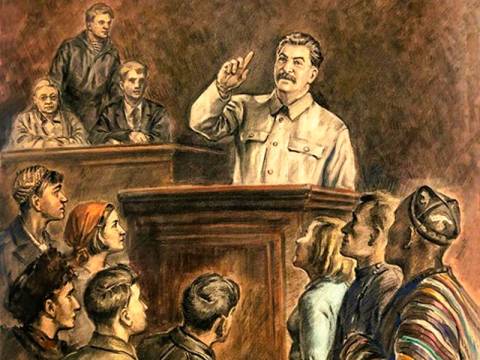
We have plenty of people willing to build and direct the work of construction both in agriculture and industry; but we have scandalously few who know how to do it. Our ignorance in this sphere is abysmal. Furthermore some among us readily extol our lack of knowledge, for if you are illiterate or nearly so and are proud of your backwardness—you are a worker "at the bench" and you deserve honour and respect. But if you have climbed out of your illiteracy and have mastered science, then you have become an alien element divorced from the masses, you are no longer a worker.
I consider that we shall not move forward a single step until we root out this barbarism and boorishness, this barbaric attitude towards science and men of culture. The working class cannot become the real master of the country if it does not succeed in overcoming its lack of culture, if it does not create its own intelligentsia, if it does not master science or does not learn how to administer the economy along scientific lines.
[...]
In order to build we must have knowledge, mastery of science. And knowledge entails study. We must study perseveringly, patiently. We must learn from everyone, both enemies and friends, especially from our enemies. We must clench our teeth and study, not fearing that our enemies may laugh at us, at our ignorance, at our backwardness.
Before us stands a fortress. That fortress is called "Science" with its numerous branches of knowledge. We must capture that fortress at all costs. Our youth must capture that fortress if they want to build the new life, if they want to be true heirs of the Old Guard.
We cannot confine ourselves now to training communist cadres in general, Bolshevik cadres in general, people who can prattle a little about everything. Dilettantism and the know-it-all attitude will now shackle our feet. We now need Bolshevik experts in metallurgy, textiles, fuel, chemistry, agriculture, transport, trade, accounting, and so on and so forth. We now need whole groups, hundreds and thousands of new Bolshevik cadres capable of mastering their subject in the most diverse branches of knowledge. Failing this, it's useless to think about a swift rate of socialist construction in our country. Failing this, it's useless to suppose we can overtake and outstrip the advanced capitalist countries.
We must master science, we must train new cadres of Bolshevik experts in all branches of knowledge, we must study, study and study most perseveringly. That is the task now.
A mass campaign of the revolutionary youth for science. That's what we need now, comrades.4
(Stormy applause. Cries of "Hurrah!" and "Bravo!" All rise.)
3. BUKHARIN'S GROUP AND THE RIGHT DEVIATION IN OUR PARTY.
Comrades, sad though it is, we have to record the fact that a separate Bukharin group has formed inside our Party. The group consists of Bukharin, Tomsky and Rykov. The Party knew nothing about its carefully concealed existence. But now the fact is known and evident.
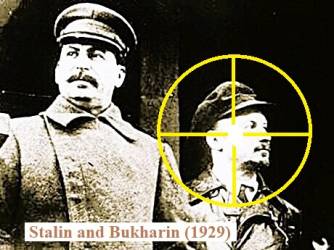
This group, as their statement reveals, has its own separate platform counterposed to the policy of the Party. Firstly it demands, in opposition to the current policy of the Party, a slower rate of industrialization, asserting that the present industrialization rate is "fatal"; secondly it demands, also in opposition to the policy of the Party, the curtailment of the creation of state farms and collective farms, asserting that they do not and cannot play a serious role in the betterment of our agriculture: thirdly it demands, also in opposition to the policy of the Party, the granting of full freedom to private trade and the renunciation of the regulating function of the state in the sphere of trade, asserting that the regulating function of the state hampers the growth of trade.
In other words, Bukharin's group is a group of Right deviators and capitulators who advocate not the eradication of the capitalist elements in our economy but their freedom of action in town and country.
At the same time, Bukharin's group opposes the emergency measures taken against the kulaks as well as their "excessive" taxation, and unceremoniously levels against the Party the accusation that, by applying such measures, it is in point of fact conducting a policy of "military and feudal exploitation of the peasantry." Bukharin needed this ludicrous accusation in order to take the kulaks under his wing and in so doing equated and lumped together the labouring peasants and the kulaks.
Bukharin's group demands that the Party radically alter its policy along the lines of the group's platform. They declare further that if the Party's policy is not altered, Bukharin, Rykov and Tomsky will formally resign.
Such are the facts established in the course of the discussion at this joint meeting of the Political Bureau of the Central Committee and the Presidium of the Central Control Commission.
Moreover it has been established that Bukharin conducted secret negotiations with Kamenev on the creation of a bloc of Bukharinites and Trotskyists against the Party and its Central Committee. Evidently having no hope that their platform would carry the day in the Central Committee the Bukharinites thought it necessary to form such a bloc behind the back of the Party’s Central Committee.1
[...]
4. THE DELIGHTS OF A REGIME.
Chronicle of Half A Century. Year 1928 |
Adventures of the Little Chinese (1928) |
Source Left: Soviet films, plays and television programs.
Four clips were extracted from this video and subsequently spliced with BeeCut plus compressed with FreeConvert.
Source Right: All soviet movies on RVISION.
Moscow: A clandestine handbill published by a faction of the Opposition is circulating in Leningrad, Moscow and several provincial centers. The pamphlet lists the immediate demands of the working class: freedom of speech, press, association and worship, personal inviolability, abolition of the death penalty, dissolution of the Tcheka and all organs of terror, amnesty for all political prisoners, abolition of all privileges enjoyed by the members of the Communist Party or of the Comintern, return of the cooperatives, absolute freedom to run in the elections to the Soviets and voting rights for all the peasants, workers, employees, bureaucrats and retirees.
Madrid, 10: The treaty between the Russian Petroleum Society and Spain's oil monopoly was ratified in Moscow and Madrid. According to the terms of the contract Russia will export 520,000 tonnes of oil to Spain this year; this amounts to 60% of Spain's annual consumption.
Berlin: News from Riga state that serious disturbances have broken out in Riga and in Leningrad.
Constantinople: A revolutionary movement has come to life in Southern Russia. The Soviet Government has closed and mined the Black Sea ports. Apparently the movement is a protest against Trotsky's internal exile. The Red garrisons of Sevastopol and Odessa mutinied.
Caucasus: Heavy snow in the Caucasus. There is "very abundant" snow in all of south Russia. Many trains stalled.
Moscow: Newspapers comment bitterly on the rising number of intellectuals who refuse to work according to Soviet directives, opting to die of starvation. A hundred and forty-five medical doctors of Leningrad have just rejected offers of employment in the countryside offering salaries of 150-250 rubles. The Soviets have begun to ponder the option of employing violent methods to compel physicians to exercise their profession in the countryside.
Moscow: According to the Tass News Agency correspondent in Franze (Siberia) Trotsky arrived at his place of exile accompanied by his family aboard a special sleeping coach; he took seventy pieces of luggage with him.
Paris: An article by O. Rosenfeld published in Le Populaire tackles the peasant question. The article states that the peasantry is under oppression since several weeks ago. There have been more than a thousand cases opened against kulaks. More cereal is now being sold in the marketplace but there is great discontent across the entire countryside. Rykov and Kalinin say that it's dangerous to cede in this struggle. To resist the pressure, as Stalin does, implies to embark on a pitiless struggle. Pravda's editorial of February 29 paints a bleak picture. "At the end of the Civil War there were 15-16 million small farms in Russia, today there are 25 million. This is the greatest peril to the Soviet project."
London: News from Moscow state that the agrarian crisis caused by the application of Article 107 of the Soviet Criminal Code—whereby the authorities can confiscate all the food peasants refuse to sell at the official low prices—worsens alarmingly by the day. As a corollary thirty Moscow and forty Leningrad shopkeepers were jailed, charged with speculation.
Zurich: The latest workingman riots in the capital were "much more" important than first thought. More than a hundred thousand workers took part, of whom sixty-two thousand were construction workers. Various clashes between Police and protesters yielded eighteen workers, five G.P.U. agents and seven soldiers dead. There was an "infinite" number of wounded and injured. The Soviet Government ordered an immediate return of the workers to their places of origin, threatening defiant ones with being deported to a concentration camp in Siberia.
Moscow: A hundred and forty-seven workers were fired from Leningrad factories in one day alone for drunkenness. More than a thousand are in alcoholism therapy. Calculations show that eighteen thousand workdays are lost monthly in Leningrad due to drunkenness.
Moscow: Soviet authorities have expropriated the Grand Synagogue of Rostov-on-Don and turned it into a workingman's club. The famous St. Isaac Cathedral of Leningrad has been closed and will reopen shortly as a museum.
Moscow: The Soviet Government is negotiating with several German companies the construction of a metropolitan underground railway in this capital.
Moscow: Krasnaya Gazetta reports that all secondary schools of the U.S.S.R. will be militarized, i.e., there will be a bond between every High School and the nearest military divisions. Students will be required to spend some time in military camps and in garrisons.
Leningrad: Thieves yanked fifty-one magnificent granite tiles off a street. The curious note is that they sold their loot back to the Soviet Administration.
Leningrad: The Leningrad Tribunal sentenced five highwaymen to death. Apparently all five belonged to the intellectual class.
Moscow: As part of the effort to attract foreign investment for the reconstruction of Russia, the official bulletin of the Soviet Government publishes a list of concession opportunities in the public service. The list is six columns wide.
Moscow: A newly formed sect of Greek Orthodox rite in Novosibirsk anoints Karl Marx and Engels as its top saints.
Moscow: The Soviet press says that a colossal fraud uncovered in Baku linked to the exploitation of the region's oil fields has caused a loss in revenue to the Soviet State of more than 20 million rubles gold.
Moscow: The Soviet Government has introduced a tax on processional religious icons. Recently in Melekes [today Dimitrovgrad] the miraculous icon of the Blessed Lady of Kazan was subjected to a tax of six thousand rubles which was quickly covered by the faithful.
Moscow: Christian Rakovsky the former Soviet Ambassador to France, currently exiled in Astrakan for belonging to the "extremist" faction of Trotsky, has written to several friends saying that he and his family live in extreme poverty and endure all manner of privations because the pension assigned by Stalin does not cover even the purchase of the most basic foodstuffs. He adds that he can not improve his financial situation by writing because Russian newspapers turn down his articles.
Moscow: Soviet newspapers say that the peasants of several Russian regions, especially Simbirsk and Nizhny Novgorod, still subsidize Masses said for the eternal rest of Maria Feodorovna the late Empress and mother of Nicholas II.
Moscow: Izvestia says that the riots orchestrated by kulaks across Russia over the past three days brought murder, arson and other acts of violence. The kulaks took revenge on those who had betrayed them to Communist inspectors looking for caches of cereals. Near Yaroslavl farmers burned down a collective farm raised on the lands they had owned. Seven local Soviet presidents were killed, X wounded and others "terribly" mutilated. Public officials sided with the rebels in most cases. In "Izdeshkovo" (?) the Soviets shot two kulaks accused of inciting the murder of the local president.
Moscow: Successive boisterous demonstrations by a hungry and ragged multitude calling for sedition wander over the streets of the capital. Red Guards set on the crowds continually. Regrettably there were numerous victims. Demonstrators were met with volleys of gunfire by Bolshevik Army forces on Red Square. Three demonstrators were killed and twenty wounded. The city has a grim aspect.
Moscow: The subscription of the latest industrial bond demonstrates the huge difference between how the city and the countryside view the Soviet Government. While urban factories and professionals subscribed 424 million rubles, the subscription in the countryside tallied a mere forty-eight million of which twenty only were purchased by the peasants.
Moscow: Pravda publishes many cases of arson in the countryside. Every model collective farm created by the Government in the Kursk region was despoiled by the peasants. After publishing a long list of similar cases the newspaper concludes that the proletarian Tribunals must exercise more severity and lay aside all compassion.
Paris: The correspondent of Le Matin in Berlin says that according to news received from Russia a supreme tribunal of the U.S.S.R. has ordered the wholesale shooting of "numerous" peasants affiliated with anti-Soviet associations. He says that the tribunal focuses its attention on Central Asia where delegates bear a very difficult burden of ill treatment at the hands of peasants because of the mass shootings.
Tula (Western Russia): After verifying that a Soviet delegate had overtaxed them, the peasants nabbed him and severed his arms and legs.
Washington: Mr. Albert Campbell the president of Campbell Farming Corporation has left for Moscow to discuss with top Soviet officials the use of machinery and modern methods in growing wheat over a surface area of ten million acres [forty thousand square kilometers]. Mr. Campbell stated before departing that this would in no way harm the agro-industry of the United States.
Moscow: Trud the official organ of the trade unions ascribes the conflicts in Soviet towns to the resurgence of Trotsky's supporters who, says the newspaper, use all kinds of methods to discredit the authorities and circulate slanderous pamphlets openly enjoining workers to make impossible demands like higher wages or the right to strike.
The Red Terror was established by Decree Number 710 on September 5, 1918.
As justification for it Lenin said, "It is immaterial whether 90% of the Russian population perishes so long as 10% survives when the World Revolution triumphs" (First Congress of the Third International)...1
and Zinoviev said, "We need leaders who harbour toward the bourgeoisie nothing but mortal hatred, who can organize and prepare the proletariat for an implacable struggle, and who do not hesitate to employ the most violent methods against everyone who obstructs the path of our Revolution—the most ruthless Civil War known to Universal History" (address to the Council of People's Commissars).
The Council of People's Commissars created the Tcheka ("All-Russia Extraordinary Commission for the eradication of counter-revolution, speculation and sabotage") on December 27, 1918. The initials were changed to G.P.U. in the year 1922. The first director was the "ferocious and bloodthirsty" Uritsky, assassinated by a Socialist-Revolutionary. The second was Dzershinsky who died tragically in 1926.
From 1918 to 1923 the Tcheka sacrificed 1,900,000 victims in Russia.
Official Soviet organs catalogued them as follows:
|
28 1,215 6,575 8,800 12,850 48,000 54,850 105,000 192,000 260,000 355,250 850,000 ———— 1,894,568 |
bishops priests teachers medical doctors employees gendarmes officers police officers workers soldiers newspapermen and writers peasants ——— victims |
The "Lolovski" (?) concentration camp in the Baltic offers in addition to the preceding macabre tally a significant illustration of the repressive process. To this camp arrive daily groups of unhappy women sentenced to exile for their disaffection toward the regime or simply for being suspect. Upon arrival these unhappy victims of the Revolution are segregated into three categories: one ruble, 60 kopecks and 15 kopecks (aristocrats, bourgeoisies, workers) whose beauty is priced by the assigned rate. They are all assigned household duties in Red Guard lodgings and ... the satisfaction of their sexual instincts. When a top officer desires a newly arrived hapless and beautiful aristocrat he transmits the order, "Bring me a one ruble woman." And the unfortunate one goes to the sacrificial altar or liberates herself by submitting to a regime of hunger, thirst and imprisonment or by drinking the poison that some merciful soul sometimes places in her hand.
Álvaro DE LA CUEVA.
Riga: The Soviet Government has decided to underwrite the life insurance of all bureaucrats who take a post in the countryside where official employees are exposed to the vengeance of peasants and where government agents find life harder to bear with each passing day. The State will pay all insurance premiums. Economitcheskai the official Soviet organ says that the anti-Communist movement takes on alarming proportions in the rural population of Russia, for the peasants refuse to pay taxes and sell their cereal to Soviet bureaucrats; they assassinate Soviet agents and set fire to collective farms and to State buildings.
Berlin: All the news from Moscow say unanimously that a "great effervescence" pervades Russia where the G.P.U. cruelly hounds Trotsky's supporters who nevertheless persist in their activity. Even yesterday they distributed extremely violent but skilfully written pamphlets inside the garrisons and factories of Moscow. The literature puts the Soviets and the Bolshevik doctrine in a bind.
London: Unconfirmed reports from Helsingfors state that Kamenev and Zinoviev were arrested by order of the Government of the U.S.S.R. The detainees are under house arrest in Moscow.
Moscow: Trud relates a few incidents. A worker in the factory "Skorokhob" (?) of Leningrad shot at a foreman. A Donetsk miner repeatedly struck a supervisor with a bottle, injuring him severely. In other cases a hammer was hurled at an engineer's head; the engineers of a textile mill were attacked four times and three miners beat up a technician and riddled the windows of his house.
Moscow: After much hesitation the Moscow Soviet issued special I.D. cards, as Leningrad and other cities did. It's hoped the measure will persuade peasants to give up their habit of feeding white bread to herds and birds, making bread scarce in the rest of the country.
Moscow: Izvestia the governmental organ affirms in a lengthy article that the class struggle has acquired extraordinary gravity in Soviet Russia and is being waged on a "gigantic" scale due to the involvement of new segments of the population. The article states that current deficiencies in the food supply are caused by a great tide of "sabotage" of the Soviet economy. The tide is especially visible among masses of the peasantry for their proclivity to reduce the seeding area. According to Izvestia the spring season will be a time of sharp struggle, a big "political test." Mr. Uglanov, speaking at a plenary session of the Moscow Soviet, said that a kind of anti-Soviet domestic mobilization is underway. Kulaks, Nepmen and clergy stand now against the Bolshevik regime more than ever, deploying a variety of methods that can not be foiled other than by letting them feel the full force of the proletarian dictatorship. The stockpiles of bread and flour are adequate, he added, and the enemies of the Soviet Government are responsible for mishaps in the distribution network.
Moscow: Tass News Agency prints the following communiqué: "Trotsky has been expelled from the territory of the U.S.S.R. for his anti-Soviet activity, following a decision of the Politburo. Trotsky left accompanied by his family."
Riga: Two thousand five hundred Trotsky supporters arrested last month were deported to Siberia, the more prominent ones to Selevetz Island [in Lake Valdayskoye, Novgorod Oblast].
A train ran out of coal and stalled for twenty-four hours during which thirty-two deportees froze to death.
Moscow: Tass News Agency says that the Moscow Soviet has decided to issue special I.D. cards next March for the acquisition of bread. On the other hand the Soviet will maintain the current price of bread for the working class but increase it for all other classes. The Moscow Soviet also said that the available quantity of bread meets the needs of the population and that the special cards were adopted to frustrate price gouging.
| And Now For Something Completely Different |